
Leo runs marketing at a 60-person software company. On Monday a rep pings him. A prospect wants to talk to a customer in their industry by Friday.
Leo has three names. Nobody knows who was asked last week. Meanwhile, the CEO wants more G2 reviews. He has also seen a rival's ambassador community and wants one too.
Where should Leo start?
Quick answer:
- If you have under 10 customers and the founder still closes every deal: Don't build a program yet. Ask one happy customer for their words when a real deal needs them.
- If you sell to strangers and a few deals a month ask "who else uses you": Get a steady stream of honest reviews and one strong customer story.
- If you have 50 to 200 people and reps ask for references every week: Run reviews and reference calls as two jobs, each with its own owner.
- If you're big enough to run a formal program with a dedicated team: Now a community or an advisory board can pay for its upkeep.
This post helps you pick a type. Our guide to building a customer advocacy program covers setup once you've picked. If you're new to the topic, start with what customer advocacy means.
The eight types at a glance
Find the row that matches what your buyers ask for today. The "Start this when" and "Effort" columns are our judgment for B2B software teams. They're not measured costs.
| Type | What customers do | Who owns it | Effort | Start this when… | What to count |
|---|---|---|---|---|---|
| Reviews | Write a review on a site like G2 | Customer or lifecycle marketing | Low to medium: repeat asks, site rules | You sell to strangers, up to about 200 people | Recent reviews in your category |
| Reference calls | Take a call with a matched prospect | Customer marketing with sales | Medium: matching, consent, limits | Reps ask for references every week | Good requests filled |
| Customer stories | Share a problem, how they solved it, and the result | Product marketing or content, with CS | Medium: interview and approvals | Strangers start asking who else uses you | Approved stories used in live deals |
| Referrals | Introduce a peer who might buy | Growth or partnerships, with CS | Medium: tracking and follow-up | You sell to strangers and can follow up on each intro | Good intros accepted |
| Advocate hub or community with points | Pick tasks, take part, earn perks | Customer marketing or community | High: steady tasks and rewards | You're big enough for a formal program and team | Active members doing useful tasks |
| Customer advisory board | Give product or strategy input, again and again | Product or an exec sponsor | High: agendas and follow-up | You're big enough for a formal program and team | Decisions shaped, feedback closed |
| Social sharing | Post about their work in their own words | Customer marketing or social | Medium: prompts and consent | Reps ask for references every week | Posts by customers, and real replies |
| User groups or champions | Teach peers, host events, help colleagues | Community or customer education | High: leader support and events | You have 50+ people and power users who teach others | Active groups, attended sessions, leaders who stay |
Where you are changes what you need
What buyers need from your customers shifts as you grow.
- Under 10 people, founder sells. Buyers trust the founder. You have too few customers for a program. Ask for one customer's words when a real conversation calls for it.
- About 10 to 40 people, selling to strangers. Buyers ask who else uses you. One useful story and a small flow of honest reviews stop the last-minute scramble.
- About 50 to 200 people. Many deals run at once, and buyers compare you side by side with rivals. Whether a matching customer is free, and how fresh your reviews are, can win or lose a deal. A named owner and a regular process pay off most here. That's often a customer marketing owner.
- About 200 to 1,000 people. Big buyers ask for references by region, industry and risk. A community or advisory board can now have its own owner.
- 1,000+ people. Your brand helps people find you. Enterprise references and your reputation still need care.
Headcount is only a rough guide. If a 30-person team already sells into competitive enterprise deals, plan like the 50-to-200 group.
Leo sits in that group. Keep him in mind as you read the eight types.
What 15 real program pages tell customers
How we did this
We wanted to know what companies tell customers before they join an advocacy program.
On 24 September 2026 (US Pacific time), we opened 15 program pages run by software companies. Each page asks customers, users or partners to take part. Together they cover all eight types. On each page we asked five questions:
- Does it offer cash or something like a gift card?
- Does it offer a perk that isn't money, like learning or event access?
- Does it show public tiers?
- Does it say how much time it takes, or how often? (It had to give a number.)
- Does it name a team or contact who runs it?
We only counted what the page said. We didn't join, test rewards or measure results. "No" means the page didn't say it. It doesn't mean the program doesn't have it. One page, Zapier's, is a partner program, so we marked it.
| Program page | Cash or gift card | Non-cash perk | Public tiers | Time ask | Team named |
|---|---|---|---|---|---|
| Cisco Insider | Yes: store voucher | Yes: access and learning | Yes | No | Yes: Insider team |
| HubSpot Community Champions | No | Yes: visibility and learning | No | No | No |
| Atlassian Champions | No | Yes: certification and event access | No | No | No |
| Snowflake Data Superheroes | No | Yes: product access and training | No | No | No |
| Zapier Solution Partners · partners | Yes: commission | Yes: training and directory | Yes | No | No |
| Asana Ambassadors | No | Yes: learning and private community | No | No | No |
| Airtable Builder Crews | No | Yes: event support and peers | No | No | Yes: Airtable program team |
| Sales Cloud First Access | No | Yes: previews and events | No | No | No |
| Taylor Collective | Yes: gift cards | Yes: content and events | No | No | Yes: Customer Advocacy contact |
| TeamViewer Voices | No | Yes: peer and product access | No | Yes: a few minutes; no minimum | Yes: advocacy team |
| Demandbase Advocates | Yes: gift cards | Yes: conference and peer access | No | Yes: five to ten minutes to enroll | No |
| Verint Elevate | No | Yes: networking and recognition | No | No | Yes: Elevate Advocacy Team |
| SAP Customer Appreciation Network | No | Yes: learning, events, recognition | Yes | No | No |
| Webflow reference program | Yes: eGift card | Yes: peer and speaking access | No | No | No |
| Qualtrics Developer Advisory Program | No | Yes: early access and product contact | No | Yes: one event per three months | No |
| Pages that say it (of 15) | 5 | 15 | 3 | 3 | 5 |
What surprised us: All 15 pages offer a perk that isn't money. Only five offer cash, a gift card or a store voucher. Only three say how much time it takes. Only five name who runs it.
A few notes on how we counted. Some pages fit more than one box. Cisco's store voucher counts as gift-like. Atlassian's exam voucher and Qualtrics's event prizes count as non-cash perks, since Qualtrics doesn't say what the prizes are. Zapier's commission goes to service partners, not everyday users.
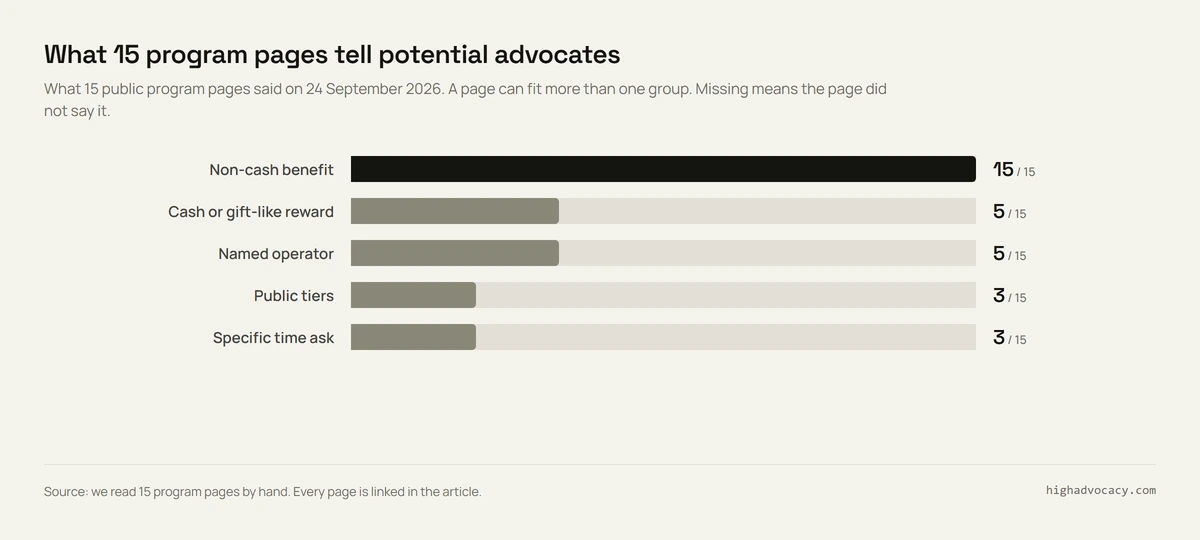
What to do with this. When you invite customers, tell them who will contact them and how often. Most pages skip both. It's easier to say yes when you know what you're signing up for. Keep in mind that these pages show what companies publish. Members may see more after they log in.
1. Reviews: start when buyers compare you in public
Do this: Ask real users, on a steady schedule, to review you on an independent site. Track reviews by how recent they are, by product and by category. Check each site's rules first.
When you first sell to strangers, a thin profile can make a buyer hesitate. At 50 to 200 people, buyers compare you with rivals in almost every deal.
Demandbase's advocate page lists a G2 review next to customer quotes, stories and other optional tasks. It says some tasks may earn a gift card, with the offer shown per task. It does not say every review gets a card.
Know the rules. G2's gift card rules require an eligible campaign and an approved review. G2 also says vendors can't ask only for positive reviews through its review collection tools.
2. Reference calls: protect your customers' time in live deals
Do this: Keep one list with who said yes, what they can speak to, when they're free, when they were last used, and their consent. Then count how many good requests you fill without wearing out the same few customers.
This is Leo's Friday problem. At 50 to 200 people, reps need a customer who matches the buyer's industry or use case. They need that person while the deal is still live.
Count a call apart from a logo permission or a testimonial. Each one takes a different amount of the customer's time.
Webflow's customer reference program offers a $50 eGift card per reference call. Advocates choose how often they're willing to help. It also offers speaking and content chances.
The price is useful to know. The bigger lesson is the limit on how often each customer is asked. A reference list breaks when sales keeps calling the same famous customer. Read our advocacy KPI guide with that risk in mind.
3. Customer stories: turn one customer's win into something every rep can use
Do this: Pick stories that answer the questions buyers keep asking. Count stories used in sales calls, not PDFs made.
Once strangers ask who else uses you, one approved story can answer the same doubt in many deals. As you grow, product marketing can pick stories to fill gaps: missing industries, integrations, or buyers worried about switching.
A story takes more work than a review. You need an interview, the customer's sign-off, a legal check, and agreement on where it can appear.
TeamViewer Voices lets customers choose to help with case studies, reviews or testimonials. Its page says joining is optional, some tasks take a few minutes, and there's no minimum. Its advocacy team reviews each application.
In your own invite, name the format, the work involved and who approves it before you ask for the interview. For real quote examples, see our B2B SaaS testimonial examples.
4. Referrals: ask for an intro to a real buyer
Do this: Write down what counts as a good intro and what the customer gets for it. Count intros accepted into a real sales process before you count revenue.
A referral is a customer putting you in touch with someone who might buy. It's not a social share or a reference call. It can work early, when a small team led by the founder can follow up in person. Later, growth or partnerships needs tracking, rules for a good lead, and a clear handoff to sales. This is one channel in customer-led growth.
Taylor Collective lists referrals next to reviews, reference calls, webinars and beta testing. It offers gift cards and other perks for some tasks. Its public page doesn't state a referral payout or what makes a referral count. Decide both before you invite anyone. Our B2B referral program guide goes deeper.
5. Advocate hub or community with points: offer a menu of tasks
Do this: Wait until you have enough members, tasks and staff to keep the menu fresh. Track useful tasks done and members who come back. A big signup number can hide an empty hub.
A hub lets members choose from stories, events, feedback, reviews and helping peers. Points and tiers take work. Someone has to check each task, explain rewards and sort out odd cases.
Cisco Insider names references, reviews, case studies and speaking as tasks that earn points. It shows Gold, Platinum and Diamond tiers, a store voucher at Platinum, and an invite-only Rockstars level. See more programs like this in our B2B loyalty programs roundup.
That range needs many kinds of help from many people. A team like Leo's, with a handful of advocates, should first prove that customers keep doing one task.
6. Customer advisory board: make sure feedback leads to decisions
Do this: Get a product leader to sponsor it. Then show members which ideas changed the roadmap.
An advisory board asks chosen customers for product or strategy input, often again and again. A marketer alone can't promise that input will change anything. It usually fits once you have many customer groups and enough product choices to justify regular sessions.
The Qualtrics Developer Advisory Program invites customers and partners in technical roles to test new features and give feedback on integrations. Its one-page overview asks for at least one event every three months. It names product roundtables and roadmap input.
That clear time ask beats a vague "join our board". But it's a program for developers. Treat its schedule as an example, not a rule for every board.
7. Social sharing: give customers an optional prompt
Do this: Suggest a useful topic and let the customer choose the words. Get permission before you reuse any post. Count posts written by customers, not reposts by your staff.
In the right professional network, a customer's own story about their work can travel farther than a brand post. You need someone who can support replies without scripting praise.
HubSpot Community Champions posts a new set of tasks each month. Some are labeled Social Amplification. Members share a link or note to earn points. The page also asks members to say when they used AI and to check facts. That beats asking every customer to "post about us" on the same day.
8. User groups or champions: help customers teach each other
Do this: Give group leaders topics, help with events, and one person to call when plans change. Count active leaders and useful sessions, not group names in a list.
A champion helps colleagues or peers learn the product. A user group gives them a place to meet. At 50 to 200 people, one active group may be enough. Bigger companies can run groups for more cities or topics.
Airtable Builder Crews are grouped by use case or location. Any Airtable user can join. Volunteer leaders host demos and talks.
Airtable says it gives event funding, program support and a network of peer leaders. The company supports the room. Users decide what their peers need to talk about.
How to choose your first program
Start with what buyers or customers already do again and again. You can run one strong program for years before you add a second.
| If this keeps happening | Start with | Check before adding a second type |
|---|---|---|
| Buyers look for peer examples, and your review profile is thin | Reviews | Users willing to write honest, specific reviews |
| Sales asks for customer calls in live, competitive deals | Reference calls | A good match, and customers who aren't overused |
| One doubt keeps coming up, and no story answers it | Customer stories | Customer sign-off on the details sales needs |
| Customers already introduce peers without being asked | Referrals | A clear handoff and tracking |
| Power users teach others and ask for a space | User groups or champions | Someone ready to support volunteer leaders |
| Product leaders need regular input from different customer groups | Customer advisory board | A sponsor who acts on the feedback |
| Advocates already do several kinds of tasks | Advocate hub | Fresh, useful tasks each month |
| Customers post their own lessons online | Social sharing | Optional prompts that respect their voice |
When reps need a review or a quote, not a call
Think back to Leo. He has two problems: thin reviews and urgent call requests. Give each its own owner and its own number to track.
For the review side, customer advocacy program software like HighAdvocacy does the collecting for you:
- It asks happy customers at the right moment: a milestone, a good NPS score, a renewal.
- It gives them an AI-assisted draft, so saying yes takes minutes.
- It collects text and video testimonials, G2, Capterra, Trustpilot and Google reviews, and LinkedIn posts, through a widget or a hosted page.
- It imports reviews you already have from 20+ sources.
- Everything goes through one approval queue, then into a Proof Library your reps can search.
- You can see the price and start free. Starter is $29/mo, or $24/mo billed yearly.
It doesn't book live reference calls or run a points-based community. If you need those, pair it with a reference tool or a community platform. The program you pick should still follow what buyers ask for and what customers are willing to do.
Your next step
Open your CRM and find the last 10 times a rep asked for customer help. Write down what each one needed: a review, a story, a call or an intro.
The most common answer is your first program. If most were reviews or stories, start HighAdvocacy free. If most were calls, set up a reference list with an owner this week.
FAQ
What is a customer advocacy program?
It's an organized way for willing customers to share their experience, help peers or advise your company. That can mean a review, a reference call, a story, an intro, a post, an event or product feedback. Each asks a different amount from the customer.
Which customer advocacy program should a small B2B SaaS company start with?
Start with what buyers already ask for. Often that's a few honest reviews or one approved customer story. If you have only a few customers, ask each one yourself before you build a program.
Can one program include several types of advocacy?
Yes. Cisco, Demandbase and SAP offer menus that mix reviews, references, stories or events. Each task still needs its own consent, time ask and success measure.
Should advocates receive rewards?
Some programs offer gift cards, vouchers or commission. All 15 pages we checked offer at least one perk that isn't money. Never tie a reward to a positive review, and check each review site's rules.
How do you measure a customer advocacy program?
Count the result tied to its job. That means recent reviews, filled reference calls, stories used in deals, or active group leaders. Our customer advocacy KPI guide has the full list.