
Leah runs marketing at a 60-person software company. On Tuesday, three people ask her for the same thing.
A sales rep needs a healthcare customer to talk to a prospect by Friday. A customer success manager knows someone who might say yes. But nobody knows if that customer already took three calls this month.
Meanwhile, Leah has a great customer quote stuck in a launch draft. The growth team is writing yet another adoption email. Everyone is working with the same customers. Nobody owns the whole thing.
Then her CEO asks: "Do we need a customer marketer?"
Quick answer:
- The short version: Customer marketing is marketing for people who already buy from you.
- It has two jobs. Help customers use, stay and grow. And turn happy customers' stories, reviews and references into help for future buyers.
- If sales keeps asking which customers will vouch for you, give this work one owner.
- Not ready to hire yet: split the tasks across people you have, using the table near the end.
Customer marketing is broader than customer advocacy. Advocacy is the part where customers share their experience. But it's not "everything after the sale" either. A support ticket, a renewal deal or a product fix still has its own owner.
What does customer marketing do?
It runs programs across your whole customer base. It decides who to reach, when to ask, and how to use a customer's success, with their permission. The work falls into two lanes.
| Lane | Typical work | Who gains first |
|---|---|---|
| Marketing to customers | Onboarding and adoption campaigns, newsletters, training, events, upsell messages | Current customers, CS, account managers |
| Marketing with customers | Case studies, reviews, references, speakers, advisory boards, referrals | Buyers, sales, product marketing, the customer who takes part |
The lanes overlap. A customer webinar can teach current users and give a buyer a peer to hear from. A case study interview can turn up an upsell idea.
So track what each activity is meant to do. Attendance alone can't show that a webinar helped a customer stay or helped close a deal.
In sales-led B2B software, a missing customer story can stall a live deal. Buyers ask for a peer in their industry, fresh reviews, or an approved story about their use case. Customer marketing gets those ready, without asking the same customer every week. This is customer-led growth in practice.
Customer marketing vs. product marketing, customer success, and lifecycle marketing
On a small team, one person may cover two of these. The lines matter when a request gets stuck and nobody picks it up.
| Team | Main question | Usually owns | Shares with customer marketing |
|---|---|---|---|
| Customer marketing | How do we engage customers and put their success to work? | Customer campaigns, advocacy programs, stories and references | Customer results, approved stories, audience lists |
| Product marketing | How do we explain the product and win the market? | Positioning, launches, competitor messaging, the sales story | Customer stories for launches and competitor claims |
| Customer success | Is this account getting value, and will it stay? | Onboarding, account health, escalations, success plans | Who might help, account context, when it's safe to ask |
| Lifecycle marketing | What message should reach this person now? | Segments, automated emails, channel tests | Customer audiences, triggers, adoption and upsell campaigns |
A handoff often goes like this. A CSM spots a great result. Customer marketing gets permission and shapes the story around a buyer's question. Product marketing puts it in a launch. Lifecycle marketing sends it to the right people.
Write these handoffs down before requests pile up. At Leah's company, nobody had.
What does a customer marketing manager own?
The job title covers reference and case study work. It also covers adoption and upsell campaigns. So describe the role by what it decides and how it's measured.
| Work owned or shared | A useful measure | Watch out for |
|---|---|---|
| Customer references | Requests filled; days from request to a willing customer; how often each customer is asked | A filled request doesn't prove it won the deal |
| Stories, case studies and reviews | Approved stories per buyer type; how fresh and how many reviews; how often sales uses them | Counting content says little about buyers |
| Advocacy and community | Active advocates; how many take part; how customers feel after an ask | A big list can hide tired or inactive people |
| Adoption and lifecycle campaigns | People reached; feature use; activity after a campaign | Split the campaign's effect from the CSM's own work |
| Upsell support | Upsell pipeline the campaigns touched; activity in target accounts | Keep "influenced" revenue apart from revenue it created |
Pick the measure that matches your pain. If sales waits days for a reference, track how long requests take. If adoption drives the business, lead with adoption.
Always show the total next to the count: requests received, customers you could ask, accounts reached. A rising count can hide a falling share.
What 25 job posts say the role does
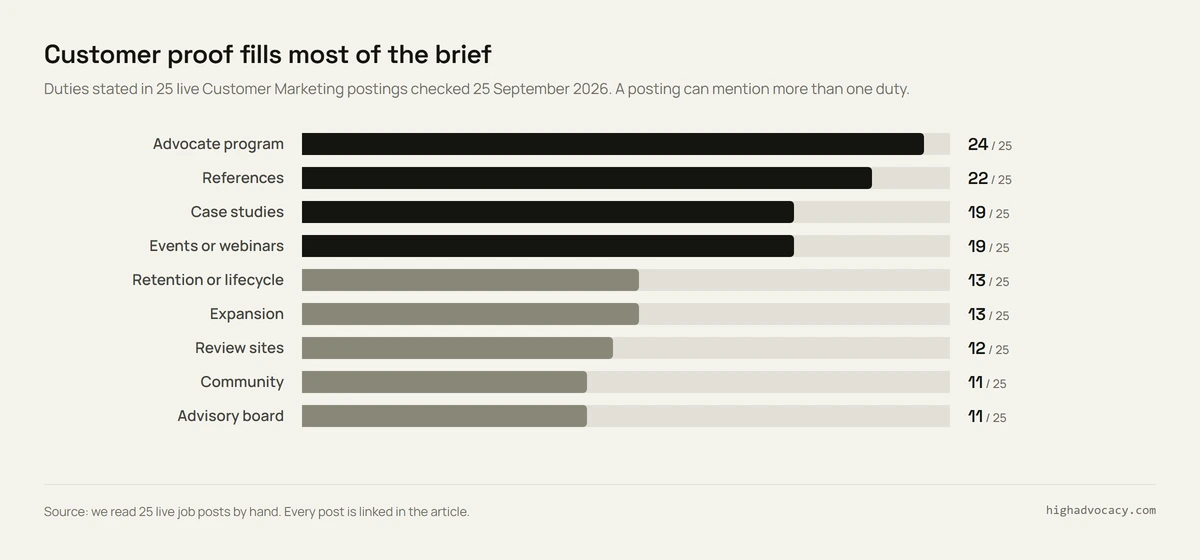
Most job posts want someone who turns happy customers into help for sales. 24 of 25 named an advocate program. 22 named references. 19 named case studies. But the role also reaches current customers. 13 named retention, and 13 named expansion (upsell).
So one title can hold both lanes. That doesn't mean they get equal time.
How we did this
We wanted to know what companies ask a customer marketer to do.
On 25 September 2026, we searched public job boards (Greenhouse, Lever and Ashby) for "customer marketing" roles. We kept 25 live posts with "Customer Marketing" in the title. If one job was posted in several cities, we counted it once. Smartsheet had two different jobs, so it shows up twice.
For each post, we read the duties and checked for nine kinds of work:
- Events or webinars
- Case studies
- An advocate program
- Retention or lifecycle work
- References
- Expansion (upsell)
- A community
- An advisory board
- Review sites
We counted a duty only if the post listed it as part of the job. A "nice to have" skill didn't count. We also noted who the role reports to, when the post said.
A job post shows what a company plans for the role. It doesn't show how the person spends their week. "Not listed" means the post didn't say.
| Company and job post | What the job owns | Reports to |
|---|---|---|
| Jumio | Events, case studies, advocates, retention, references, expansion, community, advisory board, reviews | Senior Director, Product and Program Marketing; dotted line to SVP Customer Success |
| ConnectWise | Case studies, advocates, retention, references, expansion | Not listed |
| Anthropic | Case studies, advocates, references | Not listed |
| SecurityScorecard | Events, case studies, advocates, retention, references, expansion, community, reviews | Not listed |
| Xometry | Case studies, advocates, retention, references, expansion, community, advisory board, reviews | Not listed |
| Smartsheet, regional role | Events, advocates, retention, references, expansion, community, advisory board | VP, Customer Marketing |
| Allego | Events, advocates, references, community, reviews | Not listed |
| Obsidian Security | Events, case studies, advocates, retention, references | Not listed |
| LaunchDarkly | Events, case studies, advocates, retention, expansion, advisory board, reviews | Not listed |
| Smartsheet, program role | Events | VP, Customer Marketing |
| Taxbit | Events, case studies, advocates, references, expansion, community | Not listed |
| Ethena | Events, case studies, advocates, retention, references, expansion, community, advisory board, reviews | Director, Demand Generation and Marketing Operations |
| Veeva | Events, case studies, advocates, references | Not listed |
| Pigment | Events, case studies, advocates, references, community, reviews | Head of Community and Customer Marketing |
| Insider One | Events, case studies, advocates, retention, expansion, community, advisory board, reviews | Not listed |
| Grant Street Group | Events, case studies, advocates, references | Not listed |
| Assort Health | Events, case studies, advocates, references, community, advisory board | Not listed |
| Mindtickle | Events, advocates, retention, references, expansion, reviews | Not listed |
| Avarra | Case studies, advocates, references, advisory board | Head of Marketing |
| Ivalua | Events, advocates, retention, references, expansion | Director, Customer Marketing |
| Zeta Global | Events, case studies, advocates, retention, references, expansion | President, UK |
| Campfire | Events, case studies, advocates, references, community, advisory board, reviews | Not listed |
| BLP Digital | Events, case studies, advocates, references, reviews | Not listed |
| Airwallex | Advocates, references, advisory board, reviews | Not listed |
| Solink | Case studies, advocates, retention, references, expansion, advisory board | CMO |
| Posts that name it (of 25) | Advocates 24 · References 22 · Case studies 19 · Events 19 · Retention 13 · Expansion 13 · Reviews 12 · Community 11 · Advisory board 11 | 9 listed one |
Two posts show the range well. Campfire asks the hire to "Own the customer reference program" and run review sites. Solink pairs customer stories with "programs that drive adoption, expansion, and retention."
What surprised us: only nine posts said who the role reports to. Eight named a marketing leader. Zeta Global named its UK president. Jumio added a dotted line to Customer Success.
So give the role a home in marketing and a close tie to CS. That's a pattern from 25 posts, not a rule for every org chart.
When does a company need customer marketing?
The work shows up long before the job title. A founder can ask for the first quote. A marketing generalist can write the first case study. Once the same requests keep coming back, you need one owner.
| Your situation | What customer marketing looks like | Time to change who owns it |
|---|---|---|
| Under 10 customers, and the founder still closes every deal | The founder gathers feedback and asks a few customers for a logo or quote | Not yet. There are too few customers for a program. |
| Selling to strangers, roughly 10–40 people | A generalist and the first CSM share reviews, stories and customer emails | When requests for customer stories start to slow live deals |
| 50–200 people, reps ask for references every week | A dedicated customer marketing or advocacy owner often pays off | When sales faces named rivals, asks for references again and again, and reviews sway buyers |
| Roughly 200–1,000 people | Specialists split advocacy, lifecycle, community and references | When big-account and regional requests are too much for one person |
| Big enough to run a formal program, usually 1,000+ people | Formal teams run advocacy, communications and key references | When rules and cross-region teamwork take most of the time |
Treat the headcounts as rough guides, not hiring rules. The real trigger is a sales-led team selling to strangers in a crowded market. A smaller company can hit it early.
Leah's company fits the middle row. Reps ask every week. So her answer to the CEO is yes, or at least "yes, soon."
Most requests need a story, not a call
Go back to Leah's Tuesday. Only one of the three requests needed a live call. The others needed a quote, a review or a short story, approved and easy to find.
That's the part customer advocacy program software like HighAdvocacy does well:
- It asks happy customers at the right moment, like a milestone, a good NPS score or a renewal.
- It gives them an AI-assisted draft, so saying yes takes minutes.
- It collects text and video testimonials, G2, Capterra, Trustpilot and Google reviews, and LinkedIn posts through a widget or a hosted page.
- It imports reviews you already have from 20+ sources.
- Everything goes through one approval queue, then into a Proof Library sales can search.
- You can start free. Starter is $29/mo, or $24/mo billed yearly.
It doesn't book live reference calls or run a points-based advocate community. If you need those, pair it with a reference or community tool.
How to run customer marketing before you hire
Give each repeat task a named owner, even if it's part time. Otherwise your first hire inherits missing permissions and scattered notes.
| Task | Who can own it on a small team |
|---|---|
| Which accounts are happy enough to ask, and when | The CSM or founder who owns the relationship |
| Which buyer question needs a customer story, and which deal needs a reference | The sales rep and the product marketer |
| Story interview, draft, approval record and final piece | A marketing generalist or product marketer |
| Campaign audience, timing and adoption message | A lifecycle or growth marketer, with CS review |
| Shared list of reference customers and request status | One named marketing owner, with sales and CS updating each request |
Write down who agreed to what, where their words can appear, and when they last helped. A yes to a case study is not a yes to a reference call. Let the person who owns the relationship flag a bad time.
Our guide on how to build a customer reference library covers matching and consent.
At some point one person is handling sales requests, approvals, campaigns and story follow-ups. By then it has become a full job. Give that first hire the power to set priorities with CS, product marketing and sales.
FAQ
What is the definition of customer marketing?
Customer marketing is marketing aimed at your current customers and built with the willing ones. It helps them use your product, stay and grow. It also turns their experience into approved stories for future buyers.
Is customer marketing the same as customer advocacy?
No. Advocacy is one part of it: reviews, stories, references, referrals and talks where customers share their experience. Customer marketing also covers campaigns and messages for your whole customer base.
Does customer marketing report to marketing or customer success?
Usually marketing, but not always. In the posts we read that named a boss, most named a marketing leader. Whoever owns it, write down who approves customer asks and who settles conflicts.
What should a customer marketing manager measure first?
Measure the problem that made you hire. Track how fast reference requests get filled, how many buyer types have an approved story, or adoption and upsell after campaigns.
Your next step
Leah's next move is to plan what the role does first. If the role is now clear for you too, read the growth-stage playbook. It shows what to set up, and in what order.