
Suppose a sales rep needs a relevant customer name for a live deal. Your lifecycle team needs help with adoption. Someone else wants more reviews.
Your customer marketing strategy needs a way to choose between those requests. A fixed launch calendar can send you after reviews while a different problem waits.
Start with the task that has a clear owner, a real customer or buyer need, and a result you can check. Keep the next program small enough to maintain.
Choose the problem before the program
Customer marketing includes engagement, adoption and expansion with existing customers. It also includes willing participation in reviews, stories, references and referrals. Our customer marketing definition guide covers definition and ownership. Use current product documentation for capabilities.
These are possible starting points, not a required order:
| What you need to address | Work to consider first | Check before expanding |
|---|---|---|
| Customers cannot complete an important workflow | Adoption education with CS and product | Can they complete the task afterward? |
| Buyers need independent accounts of product experience | Neutral public-review collection | Were invitations fair, and what was published? |
| Sales cannot find a relevant customer example | Reference or story retrieval | Can the owner fill the actual request? |
| A useful result has no approved account of what happened | Customer-story production | Did the customer approve the words and use? |
| Customers want to introduce peers | An opt-in referral process | Can you qualify and attribute the introductions? |
A loyalty program may address a different customer need. See the B2B loyalty program examples for that model. A product defect, security requirement or individual renewal still needs its responsible team.
What we found in four existing conversation summaries
On November 8, 2026, we reread our existing market-conversation summaries to ask which work had a concrete trigger. We read the summaries for all four people, counting each person once. Some people described both buying and selling.
For each, we recorded the trigger, the requested evidence, the recorded handoff and the exceptions. Then we compared which program the summary supported starting. We kept our interpretation separate from what the person reported.
The original interview dates are not recorded in the supplied summaries. This is a desk analysis of those summaries, not new interviews or four independent company accounts. They mostly concern advocacy and sales evidence; they do not measure the whole customer-marketing job. We have removed names and employers below.
The product marketer had uses, but no forcing deadline
The product marketer described testimonials on a website and signup page, customer words reused on LinkedIn, and examples sales could use to show the kinds of customers already buying. For regulated buyers, relevant peer examples could also help an evaluation.
Yet the same person described no precise moment when a team decided it now needed testimonials. Their value was recognized, while the work could keep being postponed. That combination gives a different starting task from an urgent review campaign: decide where a customer story will be used and who will prepare it.
We separated those proposed uses by the task they served. The website and signup placements concern the visitor considering the product. The social post concerns a competitor's user.
The buyer/seller described both review objections and product fit
One software buyer reported being happy after a demo, then choosing a more expensive alternative after reading negative reviews. The person checked whether complaints concerned features critical to their own use. They described treating negative reviews differently for a familiar major brand and a less-known software product.
On the selling side, the same subject reported prospects raising bad reviews and sometimes refusing a call. Other prospects asked about customers in their industry or region. A separate deal involved a data-residency concern about server location.
These episodes need different responses. The review objections support reading the relevant complaint, checking the issue with its owner and answering its current status. The residency question needs an authoritative technical answer. A nearby customer logo cannot establish where data is stored.
Client requests for an affiliate or referral model had also created a need to shop for that software. That trigger points to a requested introduction mechanism; it does not establish that a program launched or produced revenue.
The same buyer summary records finding options through Google AI Overviews and comparing four or five names in an LLM. The buyer also sought a recommendation from a team they trusted before another purchase.
We treated the AI steps as discovery and comparison, and the team recommendation as an experience check. The client request explains why referral software became relevant; it does not describe how the person chose among products.
For this case, record the buyer's need separately from the channel where they found or checked an answer. The reported AI steps do not establish a Google ranking method or a measured marketing result.
The account executive described a maintenance gap
An account executive reported a colleague taking three to four days to gather reference data for one prospect. Sales worked in a CRM, while Success worked in Basecamp. There was no maintained shared pool of reference information. The account explicitly recognized that the CRM could support the work; people were not maintaining it.
The requested output was often a customer name or case study. Live reference calls were rare at the ticket size described. Agencies wanted relevant success stories; the team also demonstrated live product sequences during pitches. A strategy built only around recruiting people for calls would miss these existing ways of answering a buyer.
The three-to-four-day episode is a report about a colleague's work, not our timed experiment or a benchmark. For this team, elapsed time from a specific request to a usable answer would test the reported delay. It does not establish that the delay lost a deal.
Another buyer/seller prepared matched customer examples
Another subject, describing product and service-business experience, reported a higher-ticket prospect asking for references. They supplied named customers with relevant regional and industry context. Their own matching order was region, then industry, then ticket size or risk. The team later prepared suitable customer examples before sales calls.
The same subject described broad app-store reviews as reassurance without showing which companies the reviewers represented. That is a different evidence gap from a low review total.
The same buyer/seller described two purchases with different triggers. An operational failure prompted one purchase. The end of a free product period prompted a switch in another. For that second choice, a trusted friend's recommendation was the stated main reason for choosing the alternative.
Neither episode was described as beginning with a shortage of testimonials.
The summary also mentions direct product testing alongside the reassurance of app-store reviews. It records no trial steps or results. We kept the testing comment separate from the reported purchases: it describes an evaluation preference in the notes.
An incident requires its product or support owner; the end of a free period may require a commercial decision. Customer marketing can supply relevant experience during that evaluation, without claiming to have created the operational need.
Collection was still informal. Feedback surveys had run twice, and no structured referral program was recorded. The subject followed up on poor survey answers to understand the issue. That next step was customer listening; the account does not describe sending those people an advocacy request. Meanwhile, the subject found reference recall easier in a service business with few clients than in a product company with many. A repeatable retrieval process can therefore be worth doing before a formal referral launch.
We would preserve the matching dimensions this buyer needed, rather than impose that order on every request. The subject reported that matched examples eased the close, but the summaries contain no independent attribution or measured win-rate change.
Separate the handoff gap from the evidence gap
The product marketer's and AE's summaries concerned where customer material would go and how teams would make it available. The two buyer/seller summaries also raised a different question: could the available evidence answer the risk being evaluated?
That comparison changes what to check first. A destination or handoff gap calls for an owner and a usable record. A question about product suitability calls for the right answer and its source. New collection alone would not address both kinds of gap.
Keep five useful programs available
The following mechanisms cover customer participation and buyer-facing evidence. They sit alongside adoption, engagement and expansion work. Choose the relevant one rather than launching the whole list.
Collect public reviews neutrally
Define genuine experience and destination eligibility before choosing recipients. Apply the same rule regardless of likely sentiment. A positive NPS score or quiet support history must not decide who receives a public-review invitation.
G2's in-app collection guidance prohibits positive-only segmentation. Trustpilot's September 2026 business guidelines require fair, neutral invitations and prohibit incentives connected with reviews. Check the destination's rules before offering any reward; a reward allowed elsewhere does not carry over.
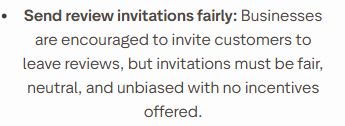
Excerpt from Trustpilot’s September 2026 business guidelines, captured November 8, 2026. Use the destination’s invitation rules before sending.
Track delivered invitations, submissions and published reviews separately. Use dated category comparisons only when they answer a buyer question. Additional positive reviews do not resolve an existing product problem.
Our seven-day review campaign guide offers a sending-plan structure. Current destination rules govern recipient selection and incentives.
Make relevant references retrievable
Record the buyer's actual region, industry, use case and risk constraints. Search for a matching approved story or named example before asking a customer for more work.
Keep the source, relationship owner, permitted uses and recent asks together. Ask separately about a live call, its topic and timing. A name in a CRM or approval of a case study is not agreement to take calls.
Agree request limits with each participant. Record a pause and rotate requests among suitable willing people. When you cannot fill a request, record whether the gap was relevance, permission, availability or missing information. Those gaps need different fixes.
Produce customer stories buyers can use
Start with a buyer question and a customer who can describe the relevant experience. Ask what changed, if anything, and what remained difficult. Include a result only when its basis and timeframe can be checked.
Keep the original account, draft version, attribution, approved destinations and final approval together. Let the customer correct the story before release. A useful qualitative account is better than an invented performance number.
Organize released stories by the questions they answer. Record when sales actually uses one. If a prospect asks for a conversation afterward, get separate agreement rather than treating the story as permission.
Offer a clear opt-in referral process
State what qualifies as an introduction, who can participate and what any reward requires. Give a willing customer an identifiable link or introduction route. Track the original introduction through qualification so an existing opportunity is not relabeled as new referral pipeline.
Review customer workload and any employer restrictions before proposing a benefit. LinkedIn activity and a high NPS score do not establish willingness to introduce someone.
Our B2B referral program guide covers the structure. Treat suggested targets and rewards as planning examples, not expected results or universal terms.
Maintain an explicitly willing advocacy pool
Ask what each person wants to do: a story, a speaker session, a reference or an introduction. Save permission for each activity, its scope and the latest ask. Let people change their mind without affecting their service.
A general membership yes does not authorize every future request. Check relevance and availability each time. Offer value the customer wants, such as learning or access to peers, rather than assuming a particular gift will motivate them.
Use advocate identification and advocacy strategy as background. Their suggested readiness scores and schedules should not become public-review filters or proven predictions.
Assign an owner and measure the chosen gap
Give one person responsibility for receiving requests and keeping their status current. Sales supplies the buyer question; Success supplies account context and flags a bad time. Product or security owns technical answers. Agree who approves publication and who can stop an ask.
For a proposed pilot, choose a review date based on actual capacity. Record the starting backlog, the work you can complete and the condition for continuing. Check whether a process you already have can do the job before adding software.
| Measure | Record the denominator or scope | What it can tell you |
|---|---|---|
| Reference fulfillment | Received and fulfilled requests; elapsed time for each | Whether requests got usable answers, and where they waited |
| Story use | Opportunities where a story was used; all opportunities reviewed | Recorded use, not revenue caused by the story |
| Referral-sourced pipeline | Qualified introductions, linked opportunity IDs and source evidence | Pipeline explicitly sourced to referrals |
| Participant activity | People who participated; eligible willing people invited in that period | Participation in the activity offered |
| Adoption work | Eligible customers reached and the defined task completion measure | Whether the intended customer behavior changed |
Choose the lead measure from the problem you selected. Keep output, influence and causal results separate. Deduplicate opportunity IDs when a story, reference and referral touch the same deal. Faster reference delivery does not by itself prove a shorter sales cycle. The customer advocacy KPI guide provides more measurement options.
Put approved customer evidence where the team can find it
Customer advocacy program software can support the collection and handoff once the job is clear. HighAdvocacy's Inbox handles campaign submissions and approval decisions. Its Library holds approved campaign submissions and imported material that your team must check before use.
The proof-details documentation shows source links and whether material is OK to feature or Internal only. Check those records before sharing. That feature status does not grant permission for a reference call, and an internal approval does not decide an external platform's moderation.
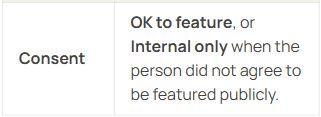
Excerpt from HighAdvocacy’s proof-details documentation, captured November 8, 2026. The field describes public featuring, not agreement to a call.
Sign in to HighAdvocacy to work with your team's campaign submissions and saved customer evidence. Start with the request you have chosen, its owner and the permission it needs.