
Imagine Priya, an account executive preparing for a prospect's call. The prospect is comparing two tools and worries about switching.
Priya asks Customer Success for a quote. They have a happy customer and send them the usual form. It asks, "What do you like about us?"
The answer comes back: "It's great."
Good testimonial questions would ask what the move involved and what changed afterward. "It's great" gives Priya neither.
Quick answer:
- Need a quote for one buyer worry? Ask about that worry, not about the product in general.
- Need a switching quote? Ask what they used before, why they changed, and what happened after.
- Need a pricing quote? Ask what cost they weighed and whether the spend was worthwhile.
- Sending a form? Pick two or three questions from the 40 below. Then follow up on anything vague. The list is a menu, not a 40-field survey.
Go to the 40 testimonial questions.
Pick questions by the job the quote has to do
Decide where the quote will go before you ask anything. Then you know what detail you need to hear. Each group below matches one or more of our 12 fill-in testimonial formats. The numbers refer to the formats in that guide.
| Question group | Use it for | Best template formats | The answer must include |
|---|---|---|---|
| Outcome and number (1–5) | Pricing page, sales deck | 1 Homepage hero; 2 Pricing; 4 Sales deck; 8 LinkedIn one-liner | A result the customer can back up |
| Before (6–10) | Case study, product page | 6 Case-study pull quote; 7 Video outline | The old task, cost, or limit |
| Doubts (11–15) | Objection slide | 2 Pricing; 5 Review-style response | The worry and what they found |
| Switching (16–20) | Comparison page | 3 Competitor switch; 5 Review-style response | Old option, trigger, and trade-off |
| Setup (21–25) | Setup pages, rollout worries | 7 Video outline; 9 Implementation | Setup work and first useful result |
| Role (26–30) | Role page, peer email | 10 Feature workflow; 11 Peer-specific proof | The speaker's job and a workflow people know |
| Recommendation (31–35) | Homepage, display card | 1 Homepage hero; 12 Website display card | Who it suits, with a caveat if needed |
| Follow-ups (36–40) | Any format | All 12 formats | The missing unit, example, or context |
Our testimonial examples show finished quotes with names and results. The questions here get the customer's own words first, before anyone edits them.
What nineteen testimonial forms asked
In our September check, broad praise appeared much more often than questions about switching, doubts or a measured result. The table shows which public forms asked for each detail.
How we did this
We wanted to know what real testimonial forms ask customers.
On 24 September 2026, we opened 19 public testimonial forms and templates from 12 vendors. Eleven showed a live form or preview. Eight listed their questions on the template page. For each one, we checked which kinds of questions it asks, like: Does it ask about results? About life before? About switching? For a number?
We only ticked a box when the question was on the page. We didn't fill in the forms, sign up, or count questions a vendor said you could add later. A tick for "Stars" means a rating scale. A tick for "Number" means the form asks for a measured result, like hours saved.
A few pages didn't make the list. Trustpilot blocked us. One Tally template showed only its intro. We found no public Testimonial.to form with questions. Two more Jotform pages wouldn't open. The 19 include five Jotform and three SurveyMonkey forms, so this isn't a picture of the whole market. A blank cell means we didn't see that question. It doesn't mean the form can't ask it.
| Form or template | Praise | Result | Before | Doubts | Switch | Recommend | Critique | Stars | Role or company | Permission | Upload | Number |
|---|---|---|---|---|---|---|---|---|---|---|---|---|
| Jotform: Testimonial | ✓ | ✓ | ✓ | ✓ | ||||||||
| Jotform: New Client | ✓ | ✓ | ✓ | ✓ | ||||||||
| Jotform: Advertising Release | ✓ | ✓ | ✓ | ✓ | ||||||||
| Jotform: Testimonial Request | ✓ | ✓ | ✓ | |||||||||
| Jotform: Customer Testimonial | ✓ | ✓ | ✓ | ✓ | ||||||||
| WPForms: Testimonial | ✓ | ✓ | ✓ | ✓ | ||||||||
| Typeform: Customer Testimonial | ✓ | ✓ | ✓ | ✓ | ✓ | ✓ | ||||||
| forms.app: Testimonial | ✓ | ✓ | ✓ | ✓ | ✓ | ✓ | ✓ | |||||
| SurveyMonkey: Customer Stories | ✓ | ✓ | ✓ | ✓ | ✓ | ✓ | ✓ | |||||
| SurveyMonkey: Customer Testimonial | ✓ | ✓ | ✓ | ✓ | ||||||||
| SurveyMonkey: Testimonial Form | ✓ | ✓ | ✓ | ✓ | ||||||||
| Tally: Feedback & Testimonial | ✓ | ✓ | ✓ | ✓ | ✓ | ✓ | ✓ | |||||
| Cognito: Testimonial | ✓ | ✓ | ✓ | ✓ | ||||||||
| Fillout: Testimonial | ✓ | ✓ | ✓ | ✓ | ✓ | |||||||
| Senja: beehiiv page | ✓ | ✓ | ✓ | |||||||||
| Senja: Freedomkit page | ✓ | ✓ | ✓ | |||||||||
| Famewall: demo page | ✓ | ✓ | ✓ | ✓ | ||||||||
| Wufoo: Testimonial* | ✓ | ✓ | ||||||||||
| Zoho: Testimonial | ✓ | |||||||||||
| Forms that ask (of 19) | 15 | 10 | 6 | 1 | 3 | 7 | 1 | 8 | 9 | 12 | 7 | 1 |
*Wufoo's live preview needs a login.
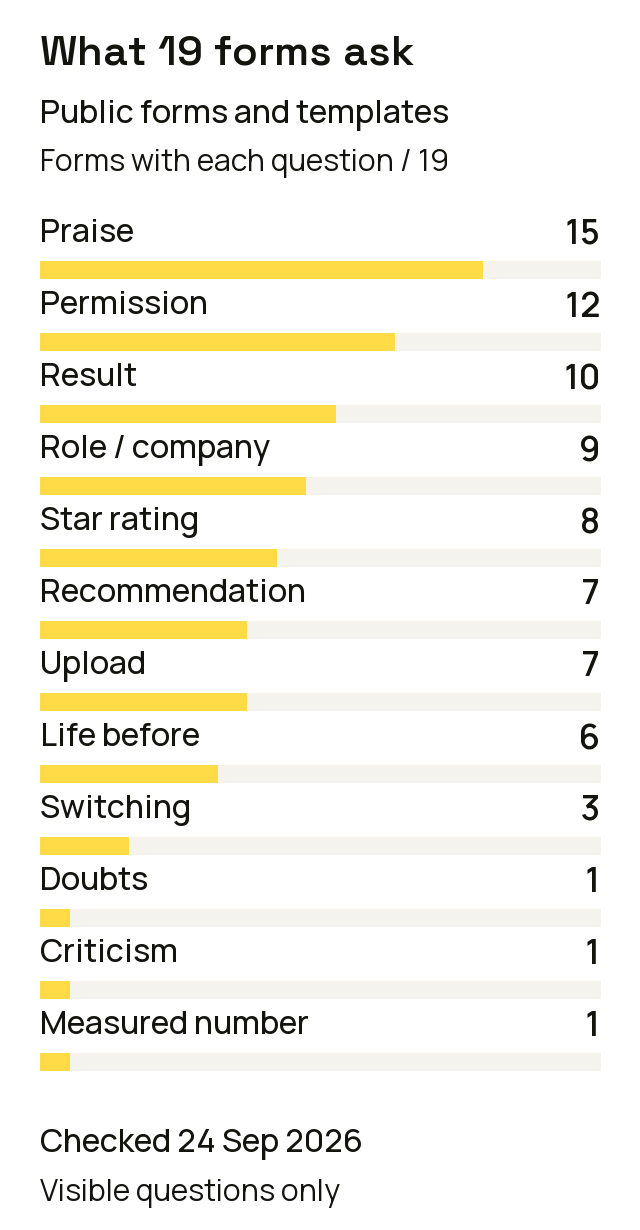
Eight forms ask for a star rating. Only one asks for a measured result. That was SurveyMonkey's Customer Stories survey.
A star score records a rating. It can't tell Priya how much a customer saved, what changed, or how long it took. Ask for a number separately, and let the customer say they don't track one. Do not use a positive score to decide who receives a public-review invitation.
The story questions were rare too. Only six forms asked about life before. Three asked about switching. One asked about a doubt the buyer had. A broad "tell us about your experience" box might still get those details, but the form didn't ask for them. Tally's form was the only one that asked what could be better. Our November recheck below found that its improvements answer is explicitly private.
Which details appeared together in the nineteen forms?
On November 2, we recalculated the combinations in the unchanged September 24 matrix. We counted a pair only when both columns had a tick in the same row. This is a closer look at those nineteen observations, not a new survey of the vendors.
| Combination in the September matrix | Forms showing both | What the rows reveal |
|---|---|---|
| Before + result | 6 of 19 | Every before question had a result question; four result forms had no before question. |
| Switching + before | 2 of 19 | Three forms asked about switching, but only two also asked about the old situation. |
| Stars + measured number | 0 of 19 | None of the eight rating forms directly requested a measured outcome. |
| Permission + role/company | 8 of 19 | Four of the twelve permission forms did not ask for a role or company. |
The switching rows were SurveyMonkey Customer Stories, SurveyMonkey Customer Testimonial and Senja Freedomkit. All three also asked about a result. Freedomkit had no separate before question in our check. That is a specific gap between naming the previous option and describing what happened while using it.
The number column was narrower than the result column. SurveyMonkey Customer Stories was the only row asking for a measured number. Nine other rows asked about results without directly requesting a metric. A blank number cell therefore does not mean an answer could never contain a number; it records what the form explicitly requested.
Permission and attribution were separate too. The four permission rows without a role/company question were Jotform Testimonial, Jotform Testimonial Request, Jotform Customer Testimonial and Tally Feedback & Testimonial. These counts describe the visible fields we checked, not whether those vendors collect attribution elsewhere.
Outcome and number questions (1–5)
Best for: Pricing pages and sales decks. Accept an unmeasured result; never supply a number for the customer.
1. What changed for your team after you started using [product] for [job]?
2. Which measure best captures that change, if you track one? How do you calculate it?
3. What was that measure before, what is it now, and over which comparable periods?
4. How has the time spent on [task] changed, if at all? Whose time are you comparing?
5. What can your team do now, and what could it do with the previous process?
Before questions (6–10)
Best for: Case studies and product pages that need the old situation.
6. What was happening when you first decided to look for a different approach?
7. Walk me through how your team completed [job] before you made the change.
8. Which parts of that process worked well, and which caused problems?
9. When a problem occurred, who handled it and what did they do?
10. How did that process affect a customer, prospect or internal stakeholder?
Doubt questions (11–15)
Best for: Objection slides, including concerns the product has not resolved.
11. Which claim, if any, were you unsure about while evaluating [product]?
12. What did you check before you felt comfortable moving ahead?
13. Which concern affected the purchase decision, if any? What did you find after using the product?
14. How did the work involved compare with what you expected?
15. What should a similar team test for itself before making the same decision?
Switching questions (16–20)
Best for: Comparison pages. Let the customer name a workflow instead of a past vendor.
16. What tool or process did you use for [job] before this one?
17. What happened that made you reconsider it at that moment?
18. What did the previous approach do well?
19. Which needs did it meet, and which remained unresolved?
20. How do you judge the results of switching against the work the move required?
Setup questions (21–25)
Best for: Setup pages and deals where rollout is the worry.
21. What happened between signing up and your first completed workflow?
22. Who handled setup, and which other people had to be involved?
23. Which steps took effort, and did any cause a delay?
24. What did your team change about its process during the first month?
25. What would you tell a peer planning the same rollout?
Role questions (26–30)
Best for: Role pages and peer emails. Keep the speaker's daily work in the answer.
26. What part of [job] do you personally own?
27. Where does [product] enter that work during a normal week?
28. How, if at all, did a report, decision or deliverable change for your role?
29. What questions can you answer now, and which still need work?
30. Which other team was affected by the change, and how?
Recommendation questions (31–35)
Best for: Homepages and display cards that need fit and a caveat.
31. Which kind of team would get the most from this product, based on your experience?
32. What should a similar buyer check before choosing it?
33. Which use case would you suggest they start with, and why?
34. If a peer asked whether the spend was worthwhile, what would you tell them from your own results?
35. What should a prospective customer know that a product page would not show them?
Follow-ups for vague praise (36–40)
Best for: Any format, after the customer made the quoted claim. Ask for the missing detail without supplying it.
36. You said it was "easy." Which step was easier, and what did that step involve before?
37. You said it "saved time." Whose time, on which task, and over what period?
38. You mentioned "great support." What happened in one request you remember?
39. You said you got "better results." Which result changed, and what is your comparison point?
40. You said you would recommend it. To whom, and what would you tell them to watch for?
Recording a video? Pick a short set of these and let the speaker answer in any order. Our video testimonials guide covers recording and publishing.
Fix weak questions before you send them
Ask about an event, comparison or limit the customer can remember. Pew Research Center's question-writing guidance recommends clear, specific wording and one concept at a time. We checked it on November 2, 2026; the prompts are suggestions, not questions tested on customers.
| Weak question | Better question | Why it works |
|---|---|---|
| Do you love our product? | What changed in your weekly [job], if anything? | Leaves room for no change. |
| How much did we improve your ROI? | Which cost or result did you track before and after, if any? | Lets the customer pick the measure, or say there isn't one. |
| Was switching easy? | Which step in the move took the most work? | Asks for a task, not agreement. |
| Would you recommend us? | Which team would you recommend it to, and what should they check first? | Gets who it fits, plus an honest caveat. |
| What features do you like? | When did you last use [feature] to finish a task? What happened next? | Links a feature to real work. |
What five source pages show about publication permission
On November 2, 2026, we returned to five sources from the September list to inspect their permission steps more closely. We chose the fields before reading: participation, destination, final-wording review, attribution and photos. Four public forms exposed questions; Typeform exposed its template description and FAQ, so we kept that source separate.
We read the public questions without entering answers, uploading files, signing or submitting anything. For Jotform, we followed the official page's Form Preview link. We did not inspect private settings or what a vendor sends after submission. A field we did not see is therefore unknown beyond that public surface. These five selected pages are a convenience comparison, not a market-wide benchmark or a legal review. The September nineteen-form totals above remain unchanged.
| Source checked November 2 | What the visible permission step distinguishes | What it does not establish |
|---|---|---|
| SurveyMonkey Customer Stories | Story-participation interest, then permission to use name/company in published materials | Which final excerpt a respondent approved |
| WPForms Testimonial | Website publication, with a separate optional personal-image upload | Which portion will be published, or permission for another channel |
| Tally Feedback & Testimonial | Marketing permission, while an improvements answer is explicitly private | That the private answer can be included in a testimonial |
| Jotform Advertising Release | Media, credited/anonymous use, likeness and a preference to review a draft | That a future draft was sent or approved |
| Typeform Customer Testimonial — description/FAQ only | Recommends asking about name/photo permission | Which fields its uninspected interactive preview actually contains |
Participation and attribution were separate in SurveyMonkey
SurveyMonkey's question 14 offers different kinds of participation, including a website review, an interview, speaking and video. It also lets someone say they are not interested. Question 15 then asks separately about publishing the person's name and company, with yes, no and contact-me choices.
Those are two distinct decisions in one visible survey. Someone can express interest in a story without having completed an interview. The name/company question refers to published materials but does not display an edited quote. We found no exact-version approval field in the public questions we read. We did not observe what happens after submission, so this finding says nothing about a later private approval process.
WPForms names a destination; Tally protects one answer
WPForms' visible permission question names the website and allows publishing part of a testimonial. Below it, an optional image upload asks whether the respondent wants a personal image attached. Name, company and job title are collected elsewhere in the same form. The visible question does not name paid ads, sales decks or social posts, and it does not display the exact portion proposed for publication.
Tally handles a different boundary. Its improvements question tells the respondent that this answer will not be published in a testimonial. Later, a yes/no question asks about using feedback in marketing materials. Reading those fields together preserves a limit that a single “permission received” label would lose: the improvements answer was given under an explicitly private instruction. The later marketing choice does not identify a final excerpt or show how a subsequent approval is handled.
Jotform offers a pre-publication review choice
Jotform's public Advertising Release preview offers a yes/no preference for reviewing the testimonial before publication. The yes choice requests a draft for approval; the no choice leaves discretion.
The same preview separates credited versus anonymous use, media choices and photo/likeness permission. It also shows duration and geographic-scope fields. Website, social, print, video/audio and email appear as distinct media choices, rather than one broad marketing permission. An optional photo upload is separate from the text testimonial.
We left these options untouched. A request to review a future draft is not a record that the draft was sent or approved. We did not observe a real submission or subsequent publication.
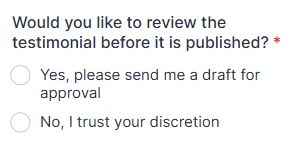
Open the official Jotform preview.
Typeform's recommendation is not an observed live field
Typeform's template FAQ recommends a name-and-photo permission question, alongside name, title and company questions. Its surrounding explanation discusses several places testimonials may be used. We could read those recommendations, but did not inspect the multi-step interactive form in this check. We therefore did not count its suggested question as a verified default field or treat unobserved steps as absent.
Across the four observable forms, Jotform explicitly offered a draft-review preference. SurveyMonkey separated participation and attribution. WPForms named website publication. Tally marked one answer private. These observations describe different decisions, not four versions of the same checkbox. None of this check measured legal sufficiency, response rates or what happened after a real submission.
Copy this testimonial form
Send a short form when the customer can't do a call. Replace the text in brackets. Then pick two or three story questions that fit where the quote will go. Priya's team would pick the switching ones.
Treat the answers as raw material. Get approval for the final copy. For timing and the outreach message, see our guide to getting customer testimonials. For a public review on a site like G2, use our review request email templates. That invitation needs a neutral eligibility rule; do not send it only to people likely to rate you positively.
CUSTOMER TESTIMONIAL FORM — TEMPLATE

We may use your answers to draft a testimonial for [specific page, deck, or campaign].
Please describe your own experience. Skip anything you cannot verify or prefer not to share.
We will send you the final wording and attribution to approve before publication.

1. Your name, job title, company, and work email (email is for follow-up, not display):
   [answer]

2. What job were you trying to do, and how did your team handle it before?
   [answer]

3. What changed after using [product]? Include a number, unit, baseline,
   and period only if you have them and can verify them.
   [answer]

4. Optional: Which concern did you have before choosing it? What did you learn in use?
   [answer]

5. Optional: What took effort, or what would you tell a similar team to check first?
   [answer]

6. Optional: May we follow up to confirm details or request a photo/logo?
   [yes / no]

Preferred public attribution: [full name / role and company / other / anonymous]
Preferred destination: [website / sales materials / social / discuss first]
Copy this permission wording
Keep permission apart from the story questions. Name each place you want to use the quote. Get approval for the final wording, the name shown, the company, and any photo. Some customers will help in private but won't agree to a public quote.
TESTIMONIAL PERMISSION — TEMPLATE

I confirm that my answers describe my own experience with [product].

I allow [company] to contact me about turning my answers into a testimonial.
Submitting this form does not by itself approve a final quote for publication.

After I review the final text and attribution, I may approve these uses
(select each that applies):
[ ] Website pages: [name pages or section]
[ ] Sales decks and one-to-one sales materials
[ ] Company social posts
[ ] Paid advertisements: [describe channels]

Attribution I approve: [name, title, company, or agreed anonymous form]
[ ] I approve the supplied headshot or company logo for the selected uses.

Source answer / interview record: [record ID or link]
Final quote/version approved: [paste or link exact version]
Approval recorded on: [date and method]
Contact for questions about use: [email]
Actual published placement / date: [record after publication]
Keep the raw answer and its private/public field label. Save the proposed excerpt with a version, then record the person's approval of that version, attribution and destinations. Fill the published-placement field only when it goes live. A change to the words or channel needs another check.
This is a working template, not legal advice. Ask a lawyer to adapt it to your country, your customer contract, image rights, and channels. The FTC's endorsement guidance says an endorsement must reflect the speaker's honest experience. It also says some connections, like a reward, may need a clear disclosure. We read it on 24 September 2026. Check the rules that apply before you publish or offer a reward.
Put the selected questions into a campaign
HighAdvocacy lets you configure a main question and detailed prompts for written or video testimonials. Its testimonial setup guide shows the fields customers see. Keep the final quote, attribution and approved destinations with the response; an internal approval is not a review platform's publication decision.
See current plans and pricing, or open the HighAdvocacy app. For Priya's switching example, start with questions 16–20 and send only the ones that fit the customer's actual experience.