
Leah runs Customer Success at a 60-person software company. Her support dashboard says CSAT is 91%. Last quarter's survey came back at NPS +38.
Then the VP of Sales forwards a prospect's email: "Your G2 page has 14 reviews and the newest is from March. Who else uses you?"
All three numbers are true. But none of them measures what the prospect is checking. The prospect wants to see customers talking about you in public. That's why CSAT vs NPS is the wrong fight.
Quick answer:
- To grade one support chat or call, use CSAT.
- To find where a task feels hard, use CES.
- To track the whole relationship over months, use NPS.
- For G2 reviews and reference calls, none of the three predicts them. A well-timed, easy ask does. NPS can help you pick the ask. It can't decide who gets a G2 invite. G2's community guidelines ban collecting reviews in a way that "exclusively targets positive reviews" (read 24 September 2026).
CSAT vs NPS vs CES at a glance
| NPS | CSAT | CES | |
|---|---|---|---|
| The question | "How likely are you to recommend us to a friend or colleague?" | "How satisfied were you with [experience]?" (wording varies by tool) | "[Company] made it easy for me to handle my issue" (agree/disagree) or "How easy was it to [task]?" |
| Scale | 0 to 10, fixed | Most often 1 to 5. Vendor docs go from 2 points to 100. | Most often 1 to 7. 1 to 5 and 3-choice versions exist too. |
| Score | % promoters (9–10) minus % detractors (0–6). Runs from -100 to +100. | % of "satisfied" answers. Usually 4 and 5 on a 5-point scale. | Average score, or % of "easy" answers (the cutoff varies) |
| What it measures | How loyal they say they are to you overall | How they felt about one moment or feature | How hard one task was |
| Looks back over | Months | Minutes to days | Minutes |
| Best time to send (B2B SaaS) | Every quarter, or near renewal | After a ticket, onboarding call or training | After setup, an integration, or a fixed issue |
| Who created it | Fred Reichheld, Bain & Company (HBR, December 2003) | No single owner | Dixon, Freeman and Toman, CEB (HBR, July–August 2010) |
| Predicts a G2 review? | No | No | No |
The exact question and scale for each
NPS: one question, one scale, one owner
NPS is the only one of the three with a fixed definition. Bain & Company still publishes it on its Net Promoter System page (read 24 September 2026).
Bain says to "start with the ultimate question, 'How likely are you to recommend us to a friend or colleague?' and score the answers on a zero-to-ten scale." Promoters answer 9 or 10. Passives answer 7 or 8. Detractors answer 0 to 6.
The idea first showed up in Fred Reichheld's December 2003 Harvard Business Review article, The One Number You Need to Grow. Bain explains the 0-to-10 scale: a zero "is never a good score," so people don't mix up the two ends. That can happen on a 1-to-10 scale.
Bain also says promoters "account for more than 80% of referrals in most businesses." That's about referrals across Bain's client work. It says nothing about review sites. We found no source that ties NPS to G2 reviews.
CSAT: many versions, no owner
Nobody owns CSAT, and the wording isn't fixed. The most common version asks, "How satisfied were you with [the experience]?" on a 1-to-5 scale, from "Very dissatisfied" to "Very satisfied."
SurveyMonkey's help doc lists those five labels and counts the top two as positive. Qualtrics does the same and calls it "top 2 box."
In real life, your CSAT scale is whatever your help desk ships with.
CES: one idea, two ways to ask
Customer Effort Score comes from CEB research. Matthew Dixon, Karen Freeman and Nick Toman published it in HBR's July–August 2010 issue as Stop Trying to Delight Your Customers. The article is behind a paywall, so we don't quote its original question here.
Vendors ask it in two ways:
- As a statement to agree with. Nicereply's help doc uses "The |COMPANY| made it easy for me to handle my issue." on a 1-to-7 scale. It calls this CES 2.0. HubSpot also uses a 7-point "Strongly agree to Strongly disagree" scale. You can't edit its question.
- As a direct question. Qualtrics describes asking, "on a scale of 'very easy' to 'very difficult', how easy was it to interact with [company name]."
Survicate's guide lists four CES wordings side by side. One is "How much effort did you personally have to put forth in handling your request?" Those four don't measure quite the same thing. Don't compare their scores as if they did.
Formulas you can copy
The numbers below are made up to show the math. Copy the block and swap in your own counts.
NPS
  NPS = % promoters (9-10) - % detractors (0-6)
  Example: 200 responses -> 110 promoters, 50 passives, 40 detractors
  110/200 = 55%   40/200 = 20%   NPS = 55 - 20 = +35
  (Passives count in the total but not in either percentage.)

CSAT (5-point, top two answers)
  CSAT = (answers of 4 or 5 / all answers) x 100
  Example: 300 responses -> 150 fives, 90 fours, 60 threes or lower
  (150 + 90) / 300 = 80%

CES (7-point agreement scale)
  Average:  sum of all scores / number of responses
  % easy:   answers at or above your "easy" cutoff / all answers
  Example: 100 responses -> 7s: 30, 6s: 25, 5s: 15, 4s: 12, 3s: 8, 2s: 6, 1s: 4
  Average = 523 / 100 = 5.23
  % easy with 6-7 as easy = 55%
  % easy with 5-7 as easy = 70%
  % easy with 4-7 as easy = 82%
HubSpot, Formbricks and Gainsight each publish one of those three CES cutoffs in their docs.
How 20 tools define CSAT and CES (our research)
Leah's 91% came from her help desk. So we checked if the tools teams use every day follow the textbook rules. Mostly, they don't.
We wanted to know how the tools you already use define these scores.
On 24 September 2026, we opened the public help docs, metric pages and survey templates of 20 well-known help desk, feedback and survey tools. That was 34 pages, all linked in the table below. For each tool we wrote down four things:
- The CSAT scales you can use.
- Which answers count as "satisfied."
- Whether it offers CES, and on what scale and cutoff.
- The NPS scale it uses.
We picked tools a growing software team is likely to have, not a random set. We didn't open accounts or test any product. We started with 21. Delighted dropped out: its CSAT help article returned HTTP 410 (gone), and its metric blog now sends you to a Qualtrics page saying "It's no longer available." "Not listed" means we didn't find it. It doesn't mean the tool can't do it.
The full table
| # | Tool | Pages we read | CSAT scales | What counts as "satisfied" | CES | NPS scale |
|---|---|---|---|---|---|---|
| 1 | Zendesk | score, settings | 1–2, 1–3, 1–5 | Top answer only: 2 of 2, 3 of 3, 4–5 of 5 | Not listed | Not listed |
| 2 | HubSpot | CSAT, CES, properties | 0–2 (Unhappy, Neutral, Happy) | Only 2 (Happy) | 1–7 agree/disagree; 6–7 = Easy | 0–10 |
| 3 | Intercom | ratings | 1–5 emoji | 4–5 | Not listed | Not listed |
| 4 | Freshdesk | CSAT module | You set it, up to 10 points | Admin sets positive, neutral and negative groups | Not listed | Not listed |
| 5 | Help Scout | ratings, report | 3 (Great, Okay, Not Good) | Net: % Great minus % Not Good | Not listed | Not listed |
| 6 | Pendo | CSAT, NPS | 3 or 5 points; numbers, emoji or stars | Not listed | Not listed | Not listed |
| 7 | Gorgias | satisfaction | 1–5 stars | 4–5 | Not listed | Not listed |
| 8 | Survicate | CSAT, service surveys | 2 to 10 points | Top half: 4–5 of 5, 5–7 of 7, 6–10 of 10 | 1–5 or 1–7; four wordings | 0–10 |
| 9 | Gainsight | survey design, CES | 1–5 labels | Not listed; labels people Promoters, Passive, Detractors | 1–7; 4–7 = low effort | 0–10 |
| 10 | Zoho Desk | happiness rating | Good, Okay, Bad ("Okay" can be turned off) | Not listed; shows % of each | Not listed | Not listed |
| 11 | Front | CSAT, score | 1–5 stars only | 4–5 | Not listed | Not listed |
| 12 | Refiner | CSAT | 2, 3, 4 or 5 points | Positive answers / all answers | Not listed | Not listed |
| 13 | Qualtrics | CSAT, CES | 1–5 | 4–5 ("top 2 box") | Very easy to very difficult; no cutoff listed | Not listed |
| 14 | Retently | CSAT, CES | 1–5, 1–7, 1–10, stars, thumbs, faces | Very satisfied + satisfied; average also offered | 1–7 agree, 1–10, 1–5, faces | Not listed |
| 15 | Hotjar (Contentsquare) | CSAT, CES | Yes/no, 5 or 7 points | Not listed | Yes/no or 1–7; average | 0–10 |
| 16 | Nicereply | metrics, scales | Smileys, thumbs, 5 stars, 10 stars | Not listed | 1–7, fixed statement | 0–10, and "1 (very unlikely) to 10" in the same article |
| 17 | SurveyMonkey | help, guide | 1–5 in help; 1–5, 1–7, 1–10 in guide | 4–5 | Not listed | Not listed |
| 18 | Zonka Feedback | metrics | 5, 10 or 100 points | Admin sets the cutoffs (10-point example: above 8) | Very easy to very difficult; average | Formula only; scale not listed |
| 19 | Kustomer | calculation | 2 to 5 choices | Converted to 5 points, then pass/fail | Not listed | Not listed |
| 20 | Formbricks | CSAT, CES | 1–5, 1–7, emoji, thumbs | 4–5 of 5 | 1–7, difficult to easy; average or % of 5–7 | Not listed |
What surprised us
Tools agree on NPS. Five tools list an NPS scale, and all five say 0 to 10. Nicereply slips once. Its article says people answer "on a scale from 1 (very unlikely) to 10 (very likely)." The next sentence says the survey "will always look the same—a scale from 0 to 10."
CSAT scales are all over the place. We counted seven scale lengths: 2, 3, 4, 5, 7, 10 and 100 points. Add stars, thumbs and emoji on top. The 5-point scale is the most common. 16 of 20 tools offer it. But some built-in surveys use something else:
- HubSpot's built-in CSAT has three points.
- Help Scout's has three faces.
- Front says, "We currently offer only the 5-star rating scale."
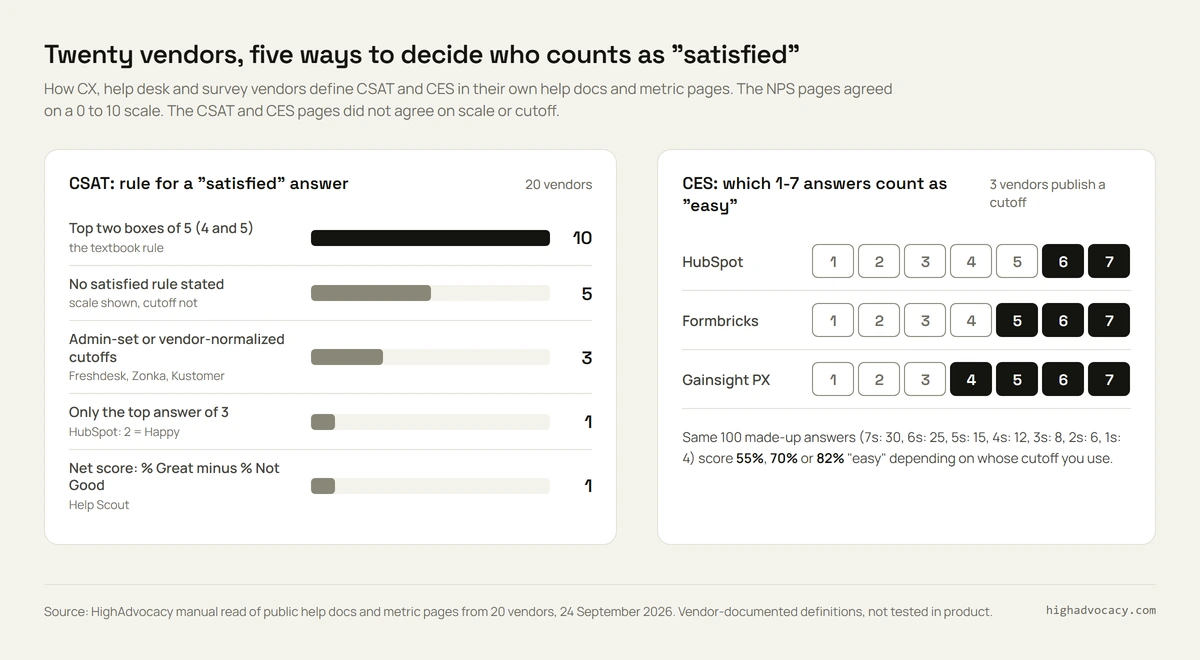
Only half use the textbook rule. Ten of 20 count the top two answers on a 5-point scale as satisfied. Five show a scale but don't say which answers count. The other five each do something different:
- HubSpot counts only "Happy," the top answer of three.
- Help Scout reports a Happiness Score worked out "much like NPS": % Great minus % Not Good.
- Freshdesk and Zonka let an admin move the cutoffs.
- Kustomer turns every scale into 5 points, then marks each rating pass or fail.
So a 91% from Intercom and a 91% from HubSpot are not the same thing. On Intercom, the second-best emoji counts as satisfied. On HubSpot, anything short of "Happy" counts against you. On Help Scout, "Okay" counts in the total, and the score can go below zero.
CES cutoffs disagree on the same scale. Nine of 20 tools offer CES. Three publish a cutoff on a 1-to-7 scale, and each draws the line in a different place. HubSpot counts 6–7 as Easy. Formbricks uses 5–7. Gainsight PX says 4–7 "implies that the user found it simpler and easier." That's why the same answers in our formula block score 55%, 70% or 82%.
Two tools borrow NPS words for CSAT. HubSpot calls a CSAT rating of 2 a "promoter" and 0 a "detractor." Gainsight's CSAT question "divides the respondents into Promoters, Passive, and Detractors." So a CSAT "promoter" in your CRM may just be someone who clicked a smiley after a password reset.
Before you compare CSAT or CES across teams, tools or years, write down three things. The scale, the exact wording, and which answers count. Then keep them fixed. If you switch help desks, expect the number to jump even if nothing changed for the customer. For churn and usage metrics too, see how to measure customer satisfaction.
When to send each survey
Match the survey to the moment. Send NPS after one support ticket and the customer rates your whole company on one chat. That's how a good account ends up marked as a detractor.
| When it happens | Send | Why | Who acts on it |
|---|---|---|---|
| Support ticket solved | CSAT or CES | Grades one chat while it's fresh | Support lead |
| Onboarding or kickoff call ends | CSAT | Their reaction to one session | Onboarding / CS |
| Setup, import or first integration done | CES | Finds friction in a task you control | Product |
| First win (first report sent, first campaign live) | CES, CSAT if you like | Checks the path to value was easy | Product, CS |
| 90 days after go-live | NPS | They know the product well enough to judge | CS, customer marketing |
| Every quarter, or 60–90 days before renewal | NPS | Tracks the relationship with time to fix things | CSM, account manager |
| New feature turned on for an account | CSAT on the feature | Narrow question, narrow answer | PM, product marketing |
| Customer leaves or downgrades | An open question, not a score | A score adds little once they've gone | CS leadership |
One rule for all of these: don't survey the same person twice in a short window. Check your tool's default. HubSpot's CSAT email, for example, only goes to contacts who "became a customer more than 30 days ago" unless you change the filter.
Which metric predicts advocacy?
None of them, directly. We looked for a published study that links NPS, CSAT or CES to G2 reviews, reference calls or case studies. We found none. Bain's referral claim above is the closest, and it's about referrals, not public reviews.
NPS asks how likely someone is to recommend you. That's a feeling. A G2 review, a LinkedIn post or a reference call is an action. Actions need three things a survey doesn't give:
- An ask. A promoter nobody invites to review you stays invisible, however high the score.
- Good timing. The ask lands right after a moment they already feel good about: a milestone, a fixed problem, a signed renewal. Our guide to the best time to ask for reviews covers these moments.
- Ease. A direct link, a clear prompt and a short task. If a customer has to find your G2 page, log in and stare at a blank box, they often give up.
That list is our judgment. We haven't measured it. But it matches our buyer interviews. In sales-led B2B deals, buyers leaned most on named references, case studies, how many G2 reviews you have, and a live demo. Satisfaction scores never came up.
Think back to Leah. Her 91% and her +38 were real. The prospect just couldn't see them. What the prospect could see was 14 G2 reviews, the newest from March.
Use NPS to pick the ask, not to pick who reviews you
NPS is useful for deciding which ask to make, and when. It can't be the filter for G2 invites.
G2's community guidelines list "Biased Review Collection" as banned. They define it as "collecting reviews by any method that segments out potentially negative reviews or exclusively targets positive reviews." The same page says: "If G2 finds evidence of a seller soliciting only positive reviews, we will remove the reviews." It also caps review rewards at $100 USD.
So "send promoters to G2, send everyone else a thank-you" is exactly what G2 bans. Our post on FTC guidelines for incentivized reviews covers the disclosure side.
This plan stays inside those rules:
| NPS answer | Next step | What to ask for |
|---|---|---|
| Detractor (0–6) | CSM follows up within a few days. Fix the issue first. | Nothing until it's fixed |
| Passive (7–8) | Ask what would make it a 9 | Nothing yet |
| Promoter (9–10) | Thank them and use their comment | Reference call, case study, testimonial, LinkedIn post, beta or advisory group |
| Every eligible customer, whatever the score | Your normal review program | G2 or Capterra invite, same wording and same reward for all |
Choosing who to ask for a reference call or case study is normal. You pick customers who look like the prospect. Choosing who to ask for a public review based on their score is what the review sites ban.
Pro tip: HighAdvocacy can trigger the promoter row automatically on a positive NPS answer, so the ask doesn't depend on someone remembering to check the survey results.
Our guide to turning NPS promoters into advocates covers the promoter row: asks by promoter type, follow-ups and rewards. The G2 review guide covers the review program for everyone else.
Track the asks, not the score
To judge an advocacy program, count what customers actually do. Track how many you ask, how many say yes, how fast new reviews arrive, and how long an ask takes to become a published review. A rising NPS won't tell you any of that. Our customer advocacy metrics guide defines 12 of these, with formulas.
Your score is private. Prospects need something public.
Leah had plenty of happy customers. None of them got an easy, well-timed ask. That's the job HighAdvocacy does well:
- It asks happy customers at the right moment: a milestone, a positive NPS answer, a renewal.
- It gives them an AI-assisted draft, so saying yes takes minutes.
- It collects text and video testimonials, G2, Capterra, Trustpilot and Google reviews, and LinkedIn posts, through a widget or a hosted page.
- It imports the reviews you already have from 20+ sources.
- Everything goes through one approval queue. Approved stories land in a library your sales team can search.
- You can start free. Starter is $29/mo, or $24/mo billed yearly.
Keep the routing table above in place. Promoters get the testimonial and reference asks. G2 invites go to every eligible customer on the same terms.
HighAdvocacy doesn't book live reference calls. If you need that, pair it with one of the customer reference tools we compared.
Your next step
Open your survey tool today. Write down your CSAT scale, its exact question, and which answers count as satisfied. Then list your last 10 promoters and check how many you asked for a review or testimonial.
If the answer is close to zero, fix the ask before you worry about the score. Start HighAdvocacy free and send your first ask this week.
FAQ
When should I use NPS vs CSAT surveys?
Use CSAT right after one moment, like a solved ticket or an onboarding call. Use NPS on a schedule, like every quarter or before renewal. Sending NPS after a support ticket mixes the two and makes both harder to read.
CSAT vs NPS: which metric should we prioritize?
Pick the one someone will act on every week. Support and onboarding teams get more from CSAT and CES, because each answer maps to a ticket or task. CS and leadership get more from NPS, because it tracks accounts over time.
Is NPS a customer satisfaction metric?
Not by its own definition. Bain calls promoters "loyal, enthusiastic fans" and passives "satisfied—for now." In that model, satisfied is the weaker state.
Can you convert CSAT to NPS or compare them?
No. They use different questions, scales and formulas. CSAT runs 0 to 100%, NPS runs -100 to +100, and even two CSAT scores from different tools may not match. Among the 20 tools we checked, five different rules decided which answers count as satisfied.
What is the difference between CSAT, NPS and CES in one line each?
CSAT asks how satisfied someone was with one experience. NPS asks how likely they are to recommend you. CES asks how easy it was to get something done.
Should CES be on a 5-point or 7-point scale?
Either works if you keep it fixed. Seven of the nine tools we found that offer CES use a 1-to-7 scale. Whichever you pick, show your "easy" cutoff next to the score.