
Here's an uncomfortable truth about B2B marketing: only 9% of buyers trust content created by vendors.
Think about that for a second. You spend hundreds of thousands of dollars producing whitepapers, case studies, and product pages, yet fewer than 1 in 10 buyers actually believe what you say.
Meanwhile, 92% of buyers trust recommendations from people they know. And 70% trust reviews left by complete strangers online.
The gap isn't about your messaging. It's not your copywriter. It's not your brand. It's structural: buyers don't trust companies talking about themselves. They trust other buyers.
That structural gap is exactly why customer advocacy has become the highest-ROI growth channel in B2B SaaS, and why every Product Marketing Manager building a go-to-market engine in 2026 needs to understand it deeply.
This guide covers everything: what customer advocacy actually is, why it matters, the different types, how to measure it, and how to build a program from scratch. Let's get into it.
What Is Customer Advocacy?
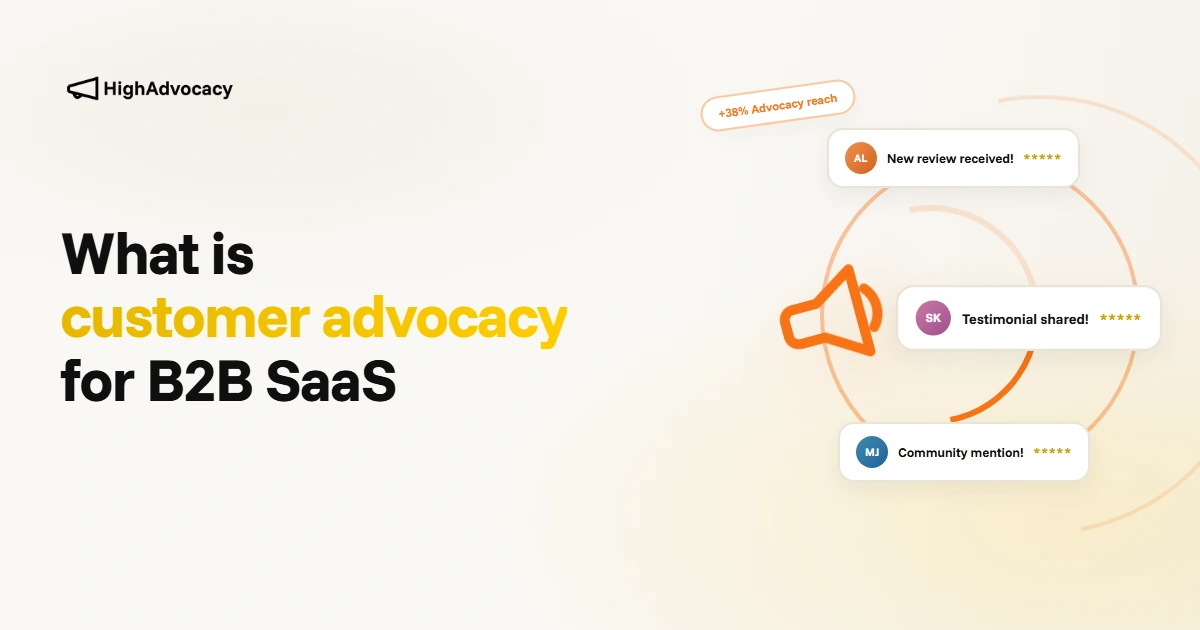
Customer advocacy is the practice of identifying, nurturing, and mobilizing satisfied customers to actively promote your brand (through reviews, testimonials, referrals, social posts, case studies, and word-of-mouth) in ways that drive real business outcomes.
The word "advocacy" comes from the Latin advocare, meaning "to call to one's aid." In a B2B context, an advocate is a customer who calls others toward your product based on their own genuine experience.
But the definition gets richer when you contrast it with what customer advocacy is not:
- It's not a Net Promoter Score survey sitting in your CRM
- It's not a spreadsheet of logos on your website homepage
- It's not a one-off "can you leave us a review?" email blast
- It's not a PR campaign or influencer program you pay for
Customer advocacy is systematic, earned, and customer-led. You build the conditions for it. Customers do the advocating.
A Simple Example
Imagine a PMM named Sarah at a 150-person SaaS company. She's been using your platform for eight months. She closed three major campaigns using insights from your tool. Her CEO noticed. Her team is happy.
Now imagine two scenarios:
Scenario A: Sarah's experience lives entirely in her head. She'd recommend you if asked, but no one asks. You keep spending $15,000/month on Google Ads.
Scenario B: At the right moment, right after her best campaign, your platform sends a personalized congratulations note and gently asks if she'd share her success story on G2. She does. That review influences 40 software evaluation decisions over the next 12 months. Two of them buy.
Same satisfied customer. Completely different business outcome.
That's the difference customer advocacy programs make.
Why Customer Advocacy Matters for B2B SaaS
The Trust Deficit Is Getting Worse
The Edelman Trust Barometer has tracked institutional trust for 20+ years, and the trend is consistent: trust in "brand content" continues to fall. In B2B specifically:
- Only 9% of buyers trust vendor content (Gartner)
- 74% of B2B buyers do more than half their research before talking to a salesperson (Forrester)
- Peer reviews influence 89% of B2B software purchasing decisions (G2)
Buyers are doing their own research (on review platforms, in communities, through their networks) before they ever engage with your sales team. If your customer voice isn't present in those channels, you've already lost significant influence over the deal.
The Economics of Advocacy vs. Paid
Let's run the math that makes this concrete for a PMM justifying budget to a CFO.
Say you have 1,000 customers. At an industry-average review ask rate, about 1% will leave a G2 review unprompted each month. That's 10 reviews.
Now you build a customer advocacy program that moves that rate to 8%. Suddenly you're generating 80 reviews per month, 70 more than before.
On G2, the data shows roughly every 3.5 reviews generates 1 demo request from a buyer who read that review. That's 20 additional demos per month.
With a typical B2B SaaS close rate of 10–15%, that's 2–3 additional deals per month, consistently, month after month, from a program that costs a fraction of your paid acquisition budget.
The ROI of customer advocacy compounds in a way paid media simply cannot. Paid turns off the moment you stop paying. A library of 200+ authentic G2 reviews works for you 24/7, indefinitely.
The Referral Effect
Advocacy doesn't stop at reviews. Customers who become active advocates refer new customers, and referred customers are categorically better:
- 37% higher retention rate than non-referred customers (Harvard Business Review)
- 18% lower churn in year one
- 25% higher lifetime value on average
A customer advocate isn't just a marketing asset. They're a compounding growth engine.
The 5 Types of Customer Advocacy
Not all advocacy looks the same. Here are the five most common forms in B2B SaaS and what makes each valuable.
1. Reviews and Ratings
The most scalable, lowest-friction form of advocacy. A customer leaves a review on G2, Capterra, TrustRadius, or Gartner Peer Insights. It takes them 5–10 minutes. It influences dozens or hundreds of future buyers.
Reviews are the foundation of any advocacy program because:
- They're always-on (working even when your team isn't)
- They're SEO-rich (review platforms rank for high-intent keywords)
- They're trusted (buyers weight third-party reviews heavily)
The challenge: most customers who would leave a positive review simply never do, because no one made it easy or timed the ask correctly.
2. Testimonials
Testimonials are structured, narrative social proof: a quote, a short video, or a story that puts a name and face behind a result. Think: "We increased our review volume by 300% in 90 days using HighAdvocacy." (Sarah K., PMM at Acme Corp)
Testimonials are more powerful than reviews because they're specific and attributable. They work especially well on landing pages, in sales decks, and in email sequences.
3. Referrals
A referral is when a customer actively introduces your product to someone in their network. This is the highest-trust, highest-conversion form of advocacy. Referral leads close at 3–5x the rate of inbound leads from paid channels.
Formal referral programs (with incentives and tracking) can systematize what previously happened accidentally.
4. Social Posts and Organic Mentions
When a customer tweets about your product, shares a LinkedIn post about a win your tool helped them achieve, or mentions you in a Slack community, that's amplified advocacy. It reaches their network, not yours.
This type of advocacy is hard to engineer directly, but you can create the conditions for it: celebrate customer wins publicly, make sharing easy, and give customers content worth sharing.
5. Case Studies and Co-Marketing
The most resource-intensive form, but also the most comprehensive. A case study tells the full story: the problem, the solution, the result. It works at every stage of the funnel and can be repurposed into blog posts, social content, sales enablement, and more.
Co-marketing (joint webinars, co-authored content, shared announcements) extends even further, turning advocates into genuine brand partners.
The Customer Advocacy Spectrum
Think of advocacy not as a binary (advocate / not advocate) but as a spectrum. Customers move through stages, and your job is to help them move up.
| Level | Behavior | Example | Business Impact |
|---|---|---|---|
| Passive | Happy but silent | NPS score of 9, never shares | None (yet) |
| Active | Takes one action when asked | Leaves a G2 review | Medium (direct influence) |
| Amplified | Shares unprompted | LinkedIn post about a win | High (reaches their network) |
| Champion | Deeply invested in your success | Joins advisory board, refers multiple customers, does case study | Very high (multiplier effect) |
Most of your happy customers sit at Passive. A good advocacy program moves them to Active. A great one creates Champions.
The key insight: the move from Passive to Active is almost entirely about friction reduction. Most passive advocates would leave a review; they just haven't been asked in the right way, at the right moment, with the right ease.
To understand where your program falls on this spectrum, take our free Customer Advocacy Maturity Quiz. It benchmarks you against other B2B SaaS companies and shows you exactly where to focus.
Who Should Build a Customer Advocacy Program?
Not every company needs a formal advocacy program, but most B2B SaaS companies past the early traction stage do. Here are the signals that you're ready:
You have 100+ customers. Below that, advocacy is mostly manual relationship management. Above it, you need systems.
Your NPS is 40+. You need a base of genuinely happy customers before you can mobilize them. Advocacy programs don't fix a broken product; they amplify satisfaction that already exists.
Your review presence is weak relative to competitors. If a buyer searches your category on G2 and sees a competitor with 300 reviews versus your 40, you're losing deals before the first conversation.
Your CAC is climbing. When paid acquisition gets expensive (and it always does), advocacy becomes your margin defense.
You have a PMM or Customer Success team with capacity. Someone needs to own the program. It doesn't need to be full-time, but it needs an owner.
If those boxes are checked, you're not just ready, you're overdue.
The 3 Pillars of an Effective Advocacy Program
Strip away the complexity and every effective advocacy program rests on three pillars.
Pillar 1: Identify
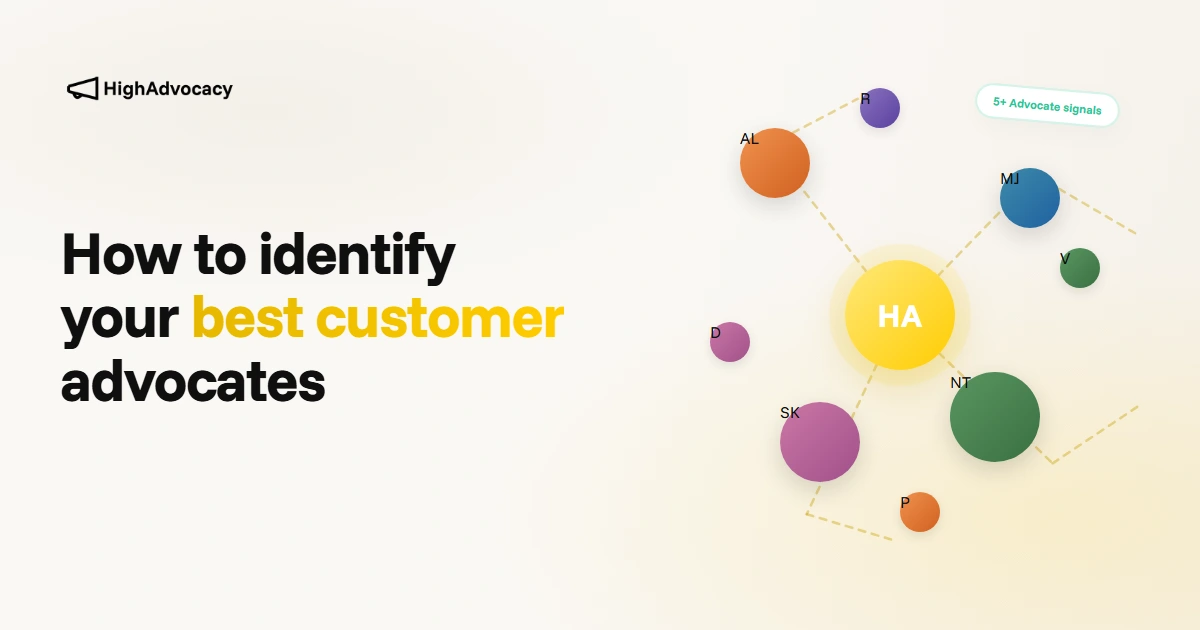
You can't mobilize advocates you haven't identified. Most companies have hundreds of potential advocates hidden in their CRM: customers with high NPS, heavy product usage, recent success moments, or existing organic mentions. They're just not surfaced.
Identification is about building a dynamic list of customers who are ready to advocate, not just happy in the abstract, but recently activated, freshly successful, and in a mindset to share.
Signals to look for:
- NPS 9–10 response in the last 30 days
- Power user behavior (daily active use, high feature adoption)
- A recent milestone (renewed contract, hit a key metric, completed onboarding)
- Already mentioning you organically on social
For a detailed playbook on this, read our guide on how to identify customer advocates.
Pillar 2: Activate
Identification means nothing without activation. Activation is the ask, and the quality of the ask determines whether it works.
The rules of effective activation:
- Time it right. Ask right after a customer win, not at a random interval.
- Make it specific. "Would you share your experience with HighAdvocacy on G2?" beats "Would you leave us a review?"
- Remove all friction. Give them a direct link. Pre-fill what you can. Keep the ask to one thing at a time.
- Frame it as their story, not your favor. "We'd love to help you share what you've built" lands differently than "Could you help us out?"
A single well-timed, well-framed ask outperforms ten generic broadcast emails.
Pillar 3: Reward
Advocates give you their time, credibility, and network. They deserve recognition. Rewards don't have to be expensive; they have to be meaningful.
Good reward mechanics:
- Instant gratification (gift cards sent the moment a review is verified)
- Exclusive access (early feature previews, advisory board invitations)
- Public recognition (spotlights in newsletters, social shoutouts)
- Reciprocal value (co-marketing, introductions, amplifying their content)
The worst mistake: promising a reward, then taking weeks to deliver it. That experience actively damages the advocate relationship.
What Customer Advocacy Is NOT
There's a lot of confusion about what advocacy programs involve. Let's clear it up.
It's not buying reviews. Review platforms like G2 and Capterra prohibit incentivized reviews that aren't disclosed. Legitimate advocacy programs reward the act of leaving a review (time + effort), not the content of the review. The review itself must be honest.
It's not a loyalty points program. Loyalty programs are transactional ("buy more, earn more"). Advocacy programs are relational ("share your genuine experience, get recognized"). The orientation is completely different.
It's not just a CS initiative. While Customer Success often owns the relationship, advocacy programs touch Marketing (reviews, case studies, social), Product (feedback loops, advisory boards), and Sales (referrals, references). It's cross-functional.
It's not a one-time campaign. A Q4 review push is a tactic. An advocacy program is an ongoing system that runs continuously, identifies new advocates as they emerge, and compounds over time.
It's not just for enterprise. Some of the best advocacy programs are at mid-market SaaS companies. In fact, if you're mid-market competing against enterprise players on G2, strong reviews can be your equalizer.
How to Measure Advocacy Impact
Advocacy suffers from the same measurement problem as brand: the impact is real but spread across channels and time horizons. Here's a framework that separates leading from lagging indicators.
Leading Indicators (Weekly / Monthly)
These tell you if your program is working right now:
- Review volume: How many new reviews on G2/Capterra this month?
- Advocate activation rate: What % of customers asked actually completed an advocacy action?
- NPS response rate: Are more customers engaging with sentiment surveys?
- Social mentions: Organic brand mentions week-over-week
- Referral submissions: New referrals entered this month
For a complete list of metrics worth tracking, see our guide on customer advocacy metrics.
Lagging Indicators (Quarterly / Annual)
These tell you if advocacy is moving the business:
- Pipeline influenced by reviews: Deals where the prospect cited a review in discovery
- Referral-sourced revenue: Revenue from customers acquired through advocate referrals
- CAC delta: How is your blended CAC trending as advocacy scales?
- Win rate on competitive deals: Are you winning more deals where review volume matters?
- Review-to-demo conversion: Track inbound demo requests that originate from review platform profiles
The gold standard: being able to tell your CFO "our advocacy program generated $X in influenced pipeline and $Y in referral revenue at a cost of $Z, delivering a Nx ROI."
If you suspect you have gaps in your review collection process, use our Review Collection Health Check to diagnose exactly where customers are dropping off.
Real Examples of Customer Advocacy Done Right
Salesforce: The Trailblazer Community
Salesforce turned customers into advocates by giving them an identity. "Trailblazers" (certified Salesforce users) became a community of millions with badges, rankings, and real career value. Advocacy wasn't a favor customers did for Salesforce. It was something they did for themselves and their peers.
Result: a self-sustaining advocacy engine that generates user-created content, peer recommendations, and referrals at a scale no marketing budget could buy.
HubSpot: Reviews as a Growth Flywheel
HubSpot was an early and aggressive mover on G2. They built dedicated processes for collecting reviews from happy customers after key milestones: onboarding completion, first campaign success, renewal. By the time competitors understood the importance of review platforms, HubSpot had a 1,000+ review moat that drove significant inbound traffic and conversion.
The lesson: review volume compounds. Starting early and being systematic creates a durable advantage.
Notion: Community-Led Advocacy
Notion didn't build a formal advocacy program. They built a community. Templates, use cases, walkthroughs: all created by users, shared publicly. Notion advocates became content creators. That content drove SEO, social proof, and product discovery simultaneously.
The lesson: when advocacy is genuinely valuable to the advocate (not just to you), it scales without heavy incentive spend.
How to Get Started Today
You don't need a six-figure budget or a dedicated team of five. Here's what to do in the next two weeks.
Step 1: Pull your NPS list. Filter for customers who scored 9–10 in the last 90 days. That's your starter advocate pool.
Step 2: Check your G2 / Capterra presence. How many reviews do you have? How does that compare to your top two competitors? That gap is your target.
Step 3: Write one activation email. A well-crafted, personalized ask triggered after a customer success moment. Not a mass blast, but one email you can test and refine.
Step 4: Set up a simple reward. Even a $25 Amazon gift card sent immediately upon review verification dramatically increases completion rates. Make the reward instant.
Step 5: Run a focused 7-day review campaign. Before building the full program, prove the model. Our guide on how to run a review campaign in 7 days walks you through exactly how to do it.
Once you've proven the model, read about scaling customer advocacy without hiring to understand how to build systems that grow without adding headcount.
And if you have an NPS program already running, don't let those promoters sit idle. Turning NPS promoters into advocates is one of the highest-leverage moves you can make.
The Bottom Line
Customer advocacy isn't a nice-to-have tactic. It's a structural response to a structural problem: buyers don't trust vendors, they trust each other.
The companies winning in B2B SaaS in 2026 aren't the ones with the biggest ad budgets. They're the ones with the most authentic, visible, and consistent customer voice: on review platforms, in communities, across social.
That voice doesn't appear by accident. It's built: systematically, deliberately, over time.
You have the raw material. Your happy customers are already out there. They just need a reason, a moment, and an easy path to speak up.
That's what a customer advocacy program gives you.
Ready to see where your advocacy program stands?
Take our free Customer Advocacy Maturity Quiz. Answer 10 questions and get a personalized score, benchmark against other B2B SaaS companies, and a roadmap of exactly what to fix first.
It takes 3 minutes. The gaps it reveals can be worth millions.