
You ran your quarterly NPS survey. The results came back strong: 200+ promoters who scored you a 9 or 10. They wrote glowing comments like "best tool we've ever used" and "completely changed how we work."
Then what happened? Nothing.
Those promoters went back to their day jobs, and their enthusiasm faded into a spreadsheet nobody opened again. Meanwhile, your G2 profile still has 23 reviews from 2024, and your competitor just crossed 150.
Sound familiar? You're sitting on a goldmine of customer goodwill and letting it evaporate. Here's how to fix that.
The Math: Why NPS Promoters Are Your Best Review Source
Before we get tactical, let's talk numbers. Not all review requests are created equal.
Conversion rates by source:
| Request Source | Average Conversion Rate |
|---|---|
| Cold email blast to all customers | 1-3% |
| CSM verbal ask during QBR | 5-8% |
| Post-support ticket request | 8-12% |
| NPS promoter follow-up (9-10 score) | 15-25% |
The reason is simple: NPS promoters have already told you they love your product. They raised their hand. They gave you permission. Asking them for a G2 review isn't a cold ask. It's a warm continuation of a conversation they started.
Here's what that looks like in practice:
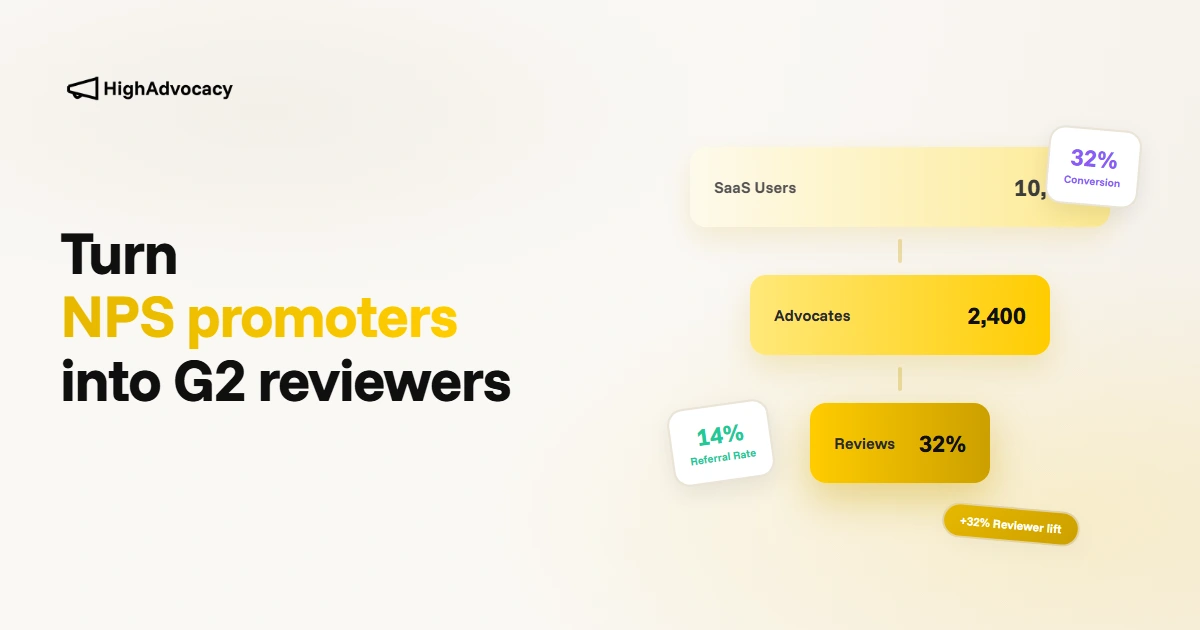
- 500 NPS responses per quarter (typical for a B2B SaaS with 1,000+ customers)
- 40% are promoters (9-10 scores) = 200 promoters
- 20% conversion on a well-timed follow-up = 40 new G2 reviews per quarter
Compare that to the 5-8 reviews you'd get from a mass email campaign. That's a 5-8x improvement from a pool of customers who already want to help you.
The 5-Step NPS-to-Review Pipeline
Turning NPS promoters into G2 reviewers isn't complicated. But it does require a system. Here are the five steps that make it work.
Step 1: Segment Your NPS Responses Immediately
This sounds obvious, but most teams skip it. The moment NPS responses come in, you need to split them into three buckets:
- Promoters (9-10): Your review candidates. These people are ready to advocate.
- Passives (7-8): Not ready for a review ask. Focus on improving their experience first.
- Detractors (0-6): Route to customer success for intervention. Never ask for a review.
The critical mistake? Treating all respondents the same. Sending a review request to a detractor doesn't just waste your time. It actively damages the relationship.
Pro tip: Within your promoter segment, prioritize those who left detailed comments. A promoter who wrote "Love it! Your reporting feature saved us 10 hours last month" is far more likely to write a G2 review than one who left the score blank.
Step 2: Time the Ask Within 24-48 Hours
Timing is everything. And most teams get it wrong.
Here's what typically happens: NPS surveys go out in January. Marketing pulls the promoter list in February. Someone drafts a follow-up email in March. By the time the ask reaches the promoter, they've forgotten why they gave you a 9.
The window for action is 24-48 hours after the NPS submission. That's when the positive sentiment is fresh. That's when they remember the specific experience that made them give you a high score.
After 48 hours, conversion rates drop by roughly 50%. After a week, you're essentially starting from scratch.
This is why manual processes fail. No PMM can review, segment, and follow up with 200 promoters within 48 hours while also doing their actual job. You need automation (more on that in Step 4).
Step 3: Make the Ask Personal
Generic follow-ups get generic results. "Thanks for your NPS feedback! Would you mind leaving us a G2 review?" reads like what it is: a mass email.
The secret weapon is referencing their specific NPS comment in your follow-up. This does two things: it shows you actually read their feedback, and it gives them a starting point for their review.
Generic ask (low conversion):
Hi Sarah, thanks for your recent feedback! We'd love it if you could share your experience on G2.
Personalized ask (high conversion):
Hi Sarah, you mentioned that our reporting feature saved your team 10 hours last month. That's incredible, and exactly the kind of insight that helps other PMMs like you find the right tools. Would you be open to sharing that experience in a quick G2 review? It takes about 5 minutes, and we'll send you a $25 gift card as a thank you.
See the difference? The second email:
- References her specific comment
- Validates her experience
- Positions the review as helping peers (not helping you)
- Sets a time expectation
- Offers a clear incentive
For email templates you can adapt right now, check out our review request email templates.
Step 4: Remove Every Possible Friction Point
Every extra click between "I'll do it" and "review submitted" costs you conversions. The biggest friction points in the NPS-to-review journey:
Friction point 1: Finding the G2 review page. Don't send people to g2.com and expect them to search for your product. Send a direct link to your G2 review submission page.
Friction point 2: Starting from a blank page. G2 reviews have structure: pros, cons, use case, recommendations. Pre-populate the review form context by including their NPS comment as a starting point. Some teams even draft a review based on the NPS feedback and let the customer edit it before submitting.
Friction point 3: Authentication hassles. G2 requires business email verification. Warn reviewers about this upfront so they're not surprised mid-flow. A simple line like "G2 will send a quick verification email to your work address" prevents drop-offs.
Friction point 4: Time uncertainty. "It takes about 5 minutes" removes the fear that this will eat into their afternoon. Be specific and honest.
Step 5: Verify and Reward Quickly
The review is submitted. Now what?
Verify within 24 hours. Don't wait until the end of the month to check who actually left reviews. The longer the gap between action and reward, the weaker the reinforcement loop.
Manual verification means logging into G2, searching for the reviewer's name, and cross-referencing with your list. For 40 reviews a quarter, that's manageable but tedious. At scale, it breaks down.
Send the reward immediately after verification. Whether it's a $25 gift card, account credits, or a charitable donation, speed matters. Instant gratification builds a positive association with the act of reviewing. It also makes them more likely to do it again.
A quick note on compliance: if you're offering incentives for reviews, you need to follow FTC guidelines for incentivized reviews. The short version: disclose the incentive, don't require positive reviews, and keep records. HighAdvocacy handles this automatically with built-in disclosure and consent capture.
The Automated NPS-to-Review Workflow
Here's what the complete pipeline looks like when it's automated:
NPS Survey Submitted (score 9-10)
        |
        v
Auto-segment: Promoter identified
        |
        v
Trigger: Personalized email sent (within 24 hrs)
  - References their NPS comment
  - Direct G2 review link
  - Clear incentive offer
        |
        v
Reminder: Gentle follow-up at 72 hours (if no action)
        |
        v
G2 Review Submitted
        |
        v
Verification: Confirm review is live on G2
        |
        v
Reward: Gift card / credits sent automatically
        |
        v
Thank you: Personal note from CS or executive
Each step happens automatically based on triggers. No spreadsheets. No manual list-pulling. No "I'll get to it next week."
The tools you need:
- NPS platform (Delighted, Wootric, Pendo, etc.) to capture scores
- Automation layer to segment promoters and trigger emails
- G2 integration to generate direct review links
- Verification system to confirm reviews were posted
- Reward management to send incentives and track compliance
You can stitch this together with Zapier and manual processes, or you can use a purpose-built platform. Either way, the workflow is the same.
5 Mistakes That Kill Your NPS-to-Review Conversion
Even with the right process, these common mistakes can tank your results:
1. Waiting Too Long to Follow Up
We covered this, but it bears repeating. Every day you wait after an NPS submission, your conversion rate drops. The promoter who was excited on Tuesday has moved on to three fires by Friday. Automate the follow-up or accept low conversion rates.
2. Sending a Generic Blast
If your follow-up looks identical to every other marketing email in their inbox, it will be treated the same way: ignored. Reference their comment. Use their name. Make it feel like a human read their feedback and is responding to it, because that's exactly what should be happening.
3. Asking Detractors for Reviews
This seems like it shouldn't need to be said, but it happens more than you'd think. Teams pull the full NPS respondent list and blast everyone. One negative G2 review from a detractor you accidentally emailed can undo the work of ten promoter reviews.
4. Making the Process Too Hard
If your review request email says "Go to G2, search for our product, click Write a Review, authenticate your email, and then write about your experience," you've already lost 80% of potential reviewers. One link. One click. Minimal steps.
5. Forgetting to Close the Loop
You asked for a review. They wrote one. Then silence. No thank you. No reward. No acknowledgment.
This isn't just bad manners. It's bad strategy. These promoters are your best advocates. Treat the review as the beginning of the relationship, not the end. Thank them, reward them, and remember them for future asks like case studies, testimonials, and referrals.
Measuring Success: Benchmarks to Track
Once your pipeline is running, track these metrics to know if it's working:
| Metric | Target Benchmark |
|---|---|
| NPS promoter identification rate | 30-45% of total NPS respondents |
| Email open rate (follow-up) | 45-60% (warm audience) |
| Click-through rate to G2 | 20-30% of opens |
| Review completion rate | 15-25% of promoters contacted |
| Time from NPS to review | Under 7 days average |
| Reward fulfillment time | Under 24 hours |
If your review completion rate is below 10%, check your timing (Step 2) and personalization (Step 3) first. Those two factors account for most of the variance.
From NPS Data to G2 Dominance
Your NPS promoters are the most underused asset in your marketing stack. They've already told you they love your product. They've already invested the time to fill out your survey. Converting them to G2 reviewers isn't about convincing reluctant customers to do something they don't want to do. It's about making it easy for willing advocates to follow through. As your review count grows, you can also use this momentum to rank higher in your G2 category and earn recognition badges.
The five-step pipeline works because it respects their time, capitalizes on their enthusiasm, and removes every obstacle between "I love this product" and "here's my public review."
For a deeper look at G2 review strategy beyond NPS, read our complete G2 reviews guide.
Stop Letting NPS Promoters Go to Waste
HighAdvocacy connects to your NPS tool and automatically triggers review requests when a promoter scores 9+. No manual segmenting. No delayed follow-ups. No spreadsheet tracking.
The moment a customer tells you they love your product, HighAdvocacy turns that signal into a G2 review, complete with personalized outreach, direct review links, AI-powered verification, and instant rewards.
No manual work required.